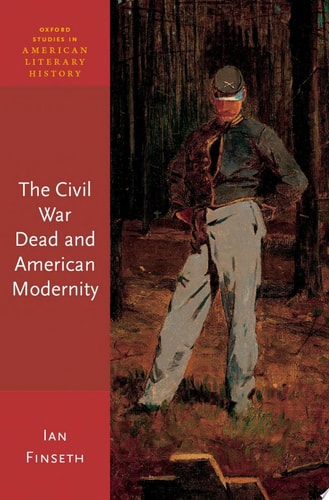
The Civil War Dead and American Modernity (Oxford Studies in American Literary History)
0
0
As an Amazon Associate and affiliate partner, Menrva Books earns from qualifying purchases. Learn more
Author Description
The Civil War Dead and American Modernity offers a fundamental rethinking of the cultural importance of the American Civil War dead. Tracing their representational afterlife across a massive array of historical, visual, and literary documents from 1861 to 1914, Ian Finseth maintains that the war dead played a central, complex, and paradoxical role in how Americans experienced and understood the modernization of the United States. From eyewitness accounts of battle to photographs and paintings, and from full-dress histories of the war to fictional narratives, Finseth shows that the dead circulated through American cultural life in ways that we have not fully appreciated, and that require an expanded range of interpretive strategies to understand. While individuals grieved and relinquished their own loved ones, the collective Civil War dead, Finseth argues, came to form a kind of symbolic currency that informed Americans' melancholic relationship to their own past. Amid the turbulence of the postbellum era, as the United States embarked decisively upon its technological, geopolitical, and intellectual modernity, the dead provided an illusion of coherence, intelligibility, and continuity in the national self. At the same time, they seemed to represent a traumatic break in history and the loss of a simpler world, and their meanings could never be completely contained by the political discourse that surrounded them. Reconstructing the formal, rhetorical, and ideological strategies by which postwar American society reimagined, and continues to reimagine, the Civil War dead, Finseth also shows that a strain of critical thought was alert to this dynamic from the very years of the war itself. The Civil War Dead and American Modernity is at once a study of the politics of mortality, the disintegration of American Victorianism, and the role of visual and literary art in both forming and undermining social consensus.
Menrva's Summary
THE THESIS
How did the collective presence of the American Civil War dead function as a symbolic currency in the construction of American modernity between 1861 and 1914? Ian Frederick Finseth, a scholar of American literature and culture, utilizes a broad interdisciplinary framework to argue that the war dead served as a stabilizing yet disruptive force in the national consciousness. By examining the tension between Victorian mourning practices and the rapid technological and geopolitical shifts of the postbellum era, the author demonstrates that the dead provided a necessary, if illusory, sense of continuity for a nation grappling with historical trauma.
THE SCOPE MAP
What You Will Find
- Analysis of visual, historical, and literary documents spanning 1861 to 1914.
- Examination of the intersection between political discourse and the politics of mortality.
- Investigation into the disintegration of American Victorianism through the lens of death and memory.
Scope Limits
- The study focuses primarily on the cultural and symbolic representation of the dead rather than a military or tactical history of the war.
- The analysis is bounded by the period ending in 1914, excluding later twentieth-century memory studies.
THE AUTHORITY PERSPECTIVE
Scholars and historians identify this work as a significant contribution to the study of American memory and the cultural impact of the Civil War. Readers frequently note the academic density of the prose and the author's rigorous application of interdisciplinary interpretive strategies.
Page Count:
296
Publication Date:
2018-01-01
Publisher:
Oxford University Press
ISBN-10:
0190848367
ISBN-13:
9780190848361
History
Cultural Anthropology
Civil War
American History
Literary Criticism
Modernity
Community Tags
Similar Books