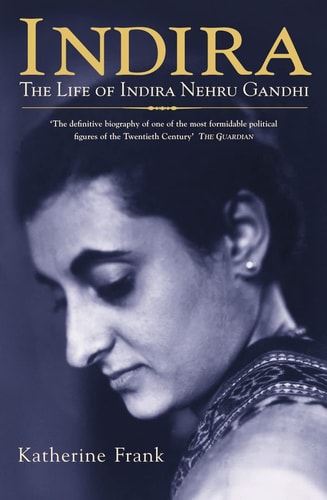
Indira: The Life of Indira Nehru Gandhi
0
0
As an Amazon Associate and affiliate partner, Menrva Books earns from qualifying purchases. Learn more
Author Description
With her latest biography Indira, Katherine Frank has chosen to grapple with the original Iron Lady of world politics. The result is a wonderfully convincing and balanced account of the life of Indira Gandhi, the mountain girl of Kashmir who rose to succeed her father, Jawaharlal Nehru, as prime minister of the world's largest democracy. A difficult childhood--her mother died early of tuberculosis and her father was frequently incarcerated by the British--saw her a frail, introverted child. Born in the same month as the Russian Revolution, she felt her life was linked to the trajectory of history, yet it took until her mid-40s, after her father had reached his dotage, for political conviction to grip her life.First sworn in as Prime Minister in 1966, Indira Gandhi quickly achieved a revered, mythic status as the mother of the nation. In all, she held the post four times, three consecutively, the last occasion coming in 1980 at the age of 63, four years before she was gunned down by her Sikh bodyguards. The Nehrus believed passionately in a secular state and Indian "oneness": it made Gandhi's factionalist assassination grimly ironic.This is a book of death and its actions. In addition to Gandhi's parents and husband, her son Sanjay, a disreputable rascal on whom she doted damagingly, was to die in a plane crash, and his brother Rajiv was assassinated in 1991. Even the author lost her husband during the six years it took to research and write the book.A tenacious demagogue rather than an ideologue, Indira personalised Indian politics, her sway coming from the natural authority of a matriarch, yet she was demonised by Salman Rushdie in Midnight's Children for her Emergency which suspended democratic practice in India. Frank, though, in appraising her subject, asserts that she was typically "sincere and deluded", and while being guilty of hubris, was no megalomaniac.Arguably each generation of Nehrus lost something of the family's intellectual rigour, and the death of R
Menrva's Summary
THE THESIS
This biography investigates the complex political evolution and personal tragedies of Indira Gandhi, the central figure of 20th-century Indian governance. Katherine Frank utilizes extensive research and historical context to examine how a reserved, introspective child transformed into a formidable matriarchal leader. The narrative explores the tension between Gandhi's commitment to a secular, unified India and the authoritarian impulses that defined her controversial tenure as Prime Minister.
THE SCOPE MAP
What You Will Find
- A comprehensive account of the Nehru-Gandhi family lineage and political dynasty.
- Analysis of the socio-political climate in India from the mid-20th century through the 1980s.
- Examination of the Emergency period and its impact on Indian democratic institutions.
- Detailed exploration of the personal losses and familial dynamics that shaped Gandhi's leadership style.
THE AUTHORITY PERSPECTIVE
The text presents a dense, analytical portrait of a polarizing political figure, balancing historical scrutiny with an examination of individual character. It serves as a scholarly resource for readers seeking to understand the intersection of personal trauma and national policy in post-colonial India.
Page Count:
592
Publication Date:
2002-01-01
Publisher:
Houghton Mifflin Harcourt (HMH)
ISBN-10:
0006387152
ISBN-13:
9780006387152
Biography
History
Politics
Women
India
Community & Culture
Asia
Community Tags
Other Editions(2)

Similar Books



Reader Comments
Share Your Thoughts
No comments yet. Be the first to share your thoughts!