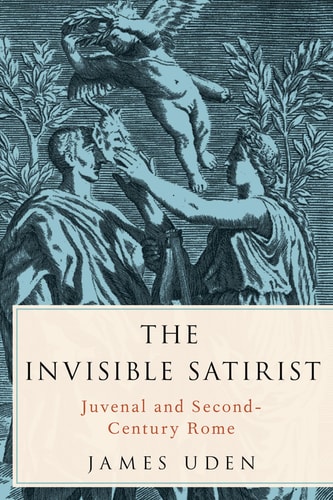
The Invisible Satirist: Juvenal and Second-Century Rome
0
0
As an Amazon Associate and affiliate partner, Menrva Books earns from qualifying purchases. Learn more
Author Description
The Invisible Satirist offers a fresh new reading of the Satires of Juvenal, rediscovering the poet as a smart and scathing commentator on the cultural and political world of second-century Rome. Breaking away from the focus in recent scholarship on issues of genre, this study situates Juvenal's Satires within the context of the politics, oratory, and philosophy of Rome under Trajan and Hadrian. In particular, the book shows how Juvenal offers a distinctively Roman response to the Greek sophists and philosophers of the so-called "Second Sophistic." Whereas earlier studies argued for the satirist's adoption of an ironic persona in his poems, this book stresses the absence of any guiding, coherent first-person voice in his work, emphasizing instead the poems' plurality of voices and thematic preoccupation with performance and disguise. These sprawling rhetorical texts, intricately constructed but deliberately lacking any strong personal voice, ultimately communicate a sense of rootlessness and loss of identity-a sense of being invisible-within the cosmopolitan second-century world. The book will appeal to students and scholars of Roman satire, Imperial Roman culture, and Second Sophistic literature.
Menrva's Summary
THE THESIS
This study investigates how the Satires of Juvenal function as a critique of the cultural and political landscape of second-century Rome, specifically challenging the traditional view of a singular ironic persona. Uden, a scholar of classical literature, utilizes a close reading of Juvenal’s texts to argue that the poems lack a coherent first-person voice. Instead, he posits that the work reflects the instability and identity crises inherent in the cosmopolitan environment of the Roman Empire under Trajan and Hadrian.
THE SCOPE MAP
What You Will Find
- Analysis of the intersection between Roman satire and the Second Sophistic movement.
- Examination of the influence of oratory and philosophy on Juvenal’s rhetorical strategies.
- Discussion of themes regarding performance, disguise, and the loss of identity.
Scope Limits
- The study does not provide a comprehensive biography of Juvenal.
- It excludes detailed linguistic analysis of the Latin meter or prosody.
THE AUTHORITY PERSPECTIVE
Scholars recognize this work as a significant departure from traditional genre-focused interpretations of Juvenal. Experts highlight the text for its sophisticated synthesis of political history and literary theory, making it a valuable resource for those studying Imperial Roman culture.
Page Count:
274
Publication Date:
2018-10-25
Publisher:
Oxford University Press
ISBN-10:
019088696X
ISBN-13:
9780190886967
History
Poetry Analysis
Juvenal
Literary Criticism
Roman History
Community Tags
Similar Books