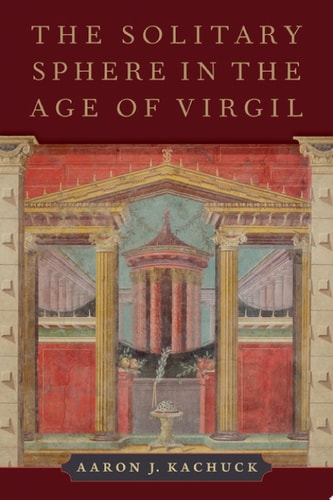
The Solitary Sphere in the Age of Virgil
0
0
As an Amazon Associate and affiliate partner, Menrva Books earns from qualifying purchases. Learn more
Author Description
The Solitary Sphere in the Age of Virgil uses an enriched tripartite model of Roman culture-touching not only the public and the private, but also the solitary-in order to present a radical re-interpretation of Latin literature and of the historical causes of this third sphere's relative invisibility in scholarship. By connecting Cosmos and Imperium to the Individual, the solitary sphere was not so much a way of avoiding politics, as a political education in itself. As re-imagined by literature in this age literature, this sphere was an essential space for the formation of the new Roman citizen of the Augustan revolution, and was behind many of the notable features of the literary revolution of Virgil's age: the expansion of the possibilities of the book of poetry, the birth of the literary cursus, new coordinations of cosmology and politics within strictly organized schemes, the attraction of first-person genres, and the subjective style. Through close readings of Cicero's late works and the oeuvres of Virgil, Horace, and Propertius and the works of other authors in the age of Virgil, The Solitary Sphere thus presents a revelatory reassessment of the classicism of classical Roman literature, and contributes to the study of pre-modern culture more generally, especially for traditions that have taken antiquity as too fixed a point in their own literary, religious, and cultural histories.
Menrva's Summary
THE THESIS
This book investigates the historical and cultural significance of the 'solitary sphere' in Roman life, arguing that it functioned as a critical space for political education rather than mere withdrawal. Aaron J. Kachuck utilizes a tripartite model of Roman culture to re-examine the relationship between the individual, the cosmos, and the empire. By analyzing the works of major Augustan authors, the author demonstrates how this sphere influenced the development of literary forms and the identity of the Roman citizen during a period of significant political transformation.
THE SCOPE MAP
What You Will Find
- A tripartite cultural framework encompassing public, private, and solitary spheres.
- Analysis of the literary evolution of poetry books and the literary cursus.
- Close readings of Cicero, Virgil, Horace, and Propertius.
- Examination of the intersection between cosmology, politics, and subjective literary style.
THE AUTHORITY PERSPECTIVE
Scholars recognize this work as a significant contribution to the study of Augustan literature and Roman cultural history. The text is noted for its academic rigor and its ability to challenge established perceptions regarding the political nature of solitude in antiquity.
Page Count:
330
Publication Date:
2021-01-01
Publisher:
Oxford University Press
ISBN-10:
019757906X
ISBN-13:
9780197579060
Philosophy
History
Literary Criticism
English
Criticism history
History & Surveys
English & College Success
Roman History
Community Tags
Similar Books