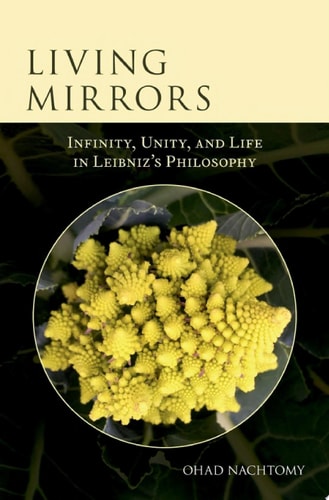
Living Mirrors: Infinity, Unity, and Life in Leibniz's Philosophy
0
0
As an Amazon Associate and affiliate partner, Menrva Books earns from qualifying purchases. Learn more
Author Description
In Living Mirrors, Ohad Nachtomy examines Leibniz's attempt to "re-enchant" the natural world-that is, to infuse life, purpose, and value into the very foundations of nature, a nature that Leibniz saw as disenchanted by Descartes' and Spinoza's more naturalistic and mechanistic theories. Nachtomy sees Leibniz's nuanced view of infinity- how it differs in the divine as well as human spheres, and its relationship to numerical and metaphysical unity-as key in this effort. Leibniz defined living beings by means of an infinite nested structure particular to what he called "natural machines"-and for him, an intermediate kind of infinity is the defining feature of living beings. Using a metaphor of a "living mirror," Leibniz put forth infinity as crucial to explaining the unity of a living being as well as the harmony between the infinitely small and the infinitely large; in this way, employing infinity and unity, we can better understand life itself, both as a metaphysical principle and as an empirical fact. Nachtomy's sophisticated and novel treatment of the essential themes in Leibniz's work will not only interest Leibniz scholars, but scholars of early modern philosophy and students of the history of philosophy and science as well.
Menrva's Summary
THE THESIS
This work investigates how Gottfried Wilhelm Leibniz utilized the concepts of infinity and unity to re-enchant the natural world against the mechanistic frameworks of his contemporaries. Ohad Nachtomy, a scholar specializing in early modern philosophy, analyzes Leibniz's metaphysical and empirical definitions of living beings. By examining the structure of natural machines, the author argues that Leibniz's unique application of infinity serves as the bridge between divine order and biological reality.
THE SCOPE MAP
What You Will Find
- Analysis of Leibniz's concept of natural machines and nested structures
- Examination of the distinction between divine and human spheres of infinity
- Exploration of the living mirror metaphor as a tool for understanding biological harmony
- Comparative study of Leibniz against Cartesian and Spinozistic mechanistic theories
Scope Limits
- The text focuses primarily on metaphysical and philosophical implications rather than modern biological science
- It does not provide a comprehensive biography of Leibniz, focusing instead on specific thematic arguments
THE AUTHORITY PERSPECTIVE
Scholars of early modern philosophy frequently cite this text for its sophisticated handling of Leibniz's complex metaphysical framework. Experts highlight the book as a significant contribution to understanding the intersection of seventeenth-century science and philosophy.
Page Count:
231
Publication Date:
2019-01-01
Publisher:
Oxford University Press
ISBN-10:
0190907347
ISBN-13:
9780190907341
History
Philosophy
Religion
Philosophy history
Early Modern
Metaphysics
Infinite
Science History
Community Tags
Similar Books