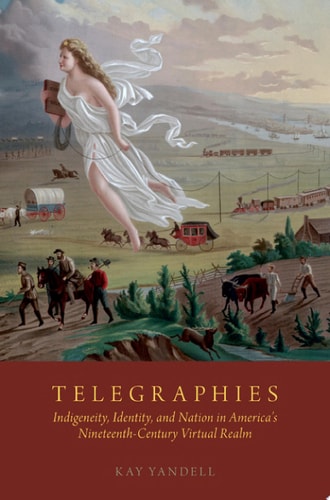
Telegraphies: Indigeneity, Identity, and Nation in America's Nineteenth-Century Virtual Realm
0
0
As an Amazon Associate and affiliate partner, Menrva Books earns from qualifying purchases. Learn more
Author Description
Telegraphies explores literatures envisioning the literary, societal, even the perceived metaphysical effects of various cultures' telecommunications technologies, to argue that nineteenth-century Americans tested in the virtual realm new theories of self, place, nation, and god. The book opens by discussing such Native American telecommunications technologies as smoke signals and sign language chains, to challenge common notions that long-distance speech practices emerged only in conjunction with capitalist industrialization. Kay Yandell analyzes the cultural interactions and literary productions that arose as Native telegraphs worked with and against European American telecommunications systems across nineteenth-century America. Into this conversation Telegraphies integrates visions of Morse's electromagnetic telegraph, with its claim to speak new, coded words and to send bodiless, textless prose instantly across the miles. Such writers as Frederick Douglass, Walt Whitman, and Ella Cheever Thayer crafted memoirs, poetic odes, and novels that envision how the birth of instantaneous communication across a vast continent forever alters the way Americans speak, write, build community, and conceive of the divine. While some writers celebrated far-speaking technologies as conduits of a metaphysical Manifest Destiny to overspread America's primitive cultures, others revealed how telecommunication could empower previously silenced voices to range free in the disembodied virtual realm, even as bodies remained confined by race, class, gender, disability, age, or geography. Ultimately, Telegraphies broadens the way literary scholars conceive of telecommunications technologies while providing a rich understanding of similarities between literatures often considered to have little in common.
Menrva's Summary
THE THESIS
This work investigates how nineteenth-century American literature conceptualized the societal, metaphysical, and identity-altering effects of emerging telecommunications technologies. Kay Yandell, a scholar of American literature, utilizes a comparative framework to examine how both Indigenous communication methods and European American systems like the electromagnetic telegraph shaped national identity. The book argues that these technologies functioned as a virtual realm where writers tested new theories regarding the self, the divine, and the structure of the nation.
THE SCOPE MAP
What You Will Find
- Analysis of Native American telecommunications including smoke signals and sign language chains.
- Examination of literary responses to Morse's electromagnetic telegraph.
- Comparative study of works by Frederick Douglass, Walt Whitman, and Ella Cheever Thayer.
- Exploration of the tension between disembodied communication and physical constraints like race, class, and gender.
Scope Limits
- The study focuses primarily on nineteenth-century American literary production.
- It does not provide a technical history of telegraphic hardware or engineering.
THE AUTHORITY PERSPECTIVE
Scholars recognize this text as a significant contribution to the intersection of media studies and nineteenth-century American literature. Readers frequently note the academic density of the prose and the author's success in bridging the gap between Indigenous communication practices and industrial-era technology.
Page Count:
221
Publication Date:
2018-01-01
Publisher:
Oxford University Press
ISBN-10:
0190901063
ISBN-13:
9780190901066
History
19th Century
Regional
In literature
Communication History
Historical
Nineteenth century
American Studies
Indigenous
Literary Criticism
Community Tags
Other Editions(2)
Similar Books














Reader Comments
Share Your Thoughts
No comments yet. Be the first to share your thoughts!