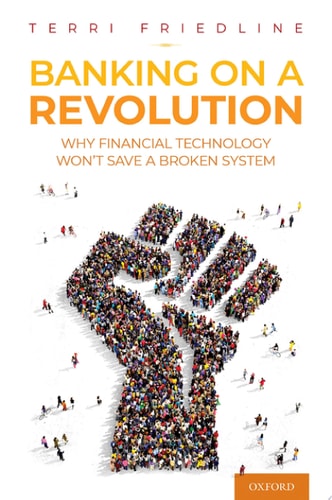
Banking on a Revolution: Why Financial Technology Won't Save a Broken System
0
0
As an Amazon Associate and affiliate partner, Menrva Books earns from qualifying purchases. Learn more
Author Description
Can grassroots social movements impact the financial system? Technological advancements are poised to completely transform the financial system, and soon it will be unrecognizable. Banks are increasingly using financial technologies ("fintech") to deliver products and services and maximize their profits. Technology enthusiasts and consumer advocates laude the field for its potential to expand access to banking and finance. However, if history is any indication, fintech stands to reinforce digital forms of redlining and enable banks' continued racialized exploitation of Black and Brown communities. Banking on a Revolution takes the perspective that the financial system needs a revolution-not the impending revolution driven by technology. Studying the various ways the financial system bolsters whites by exploiting and marginalizing Black and Brown communities, Terri Friedline challenges the optimistic belief that fintech can expand access to banking and finance. Friedline applies the lens of financialized racial neoliberal capitalism to demonstrate the financial system's inherent racism, and explores examples from student loan debt, corporate landlords, community benefits agreements, and banking and payday lending. Banking on a Revolution is deeply rooted in theory and research, and it presents new interpretations of the climate crisis, student loan debt, and community benefits agreements and their relationships to the financial system. The book makes a compelling case for a revolutionized financial system that centers the needs, experiences, and perspectives of those it has historically excluded, marginalized, and exploited.
Menrva's Summary
THE THESIS
This book investigates whether financial technology can genuinely reform a financial system that is fundamentally structured around racialized exploitation. Terri Friedline, an expert in financial policy and social work, utilizes the framework of financialized racial neoliberal capitalism to analyze the intersection of banking and systemic inequality. She argues that current technological advancements in finance, rather than expanding access, primarily serve to reinforce existing power structures and digital forms of redlining that disproportionately harm Black and Brown communities.
THE SCOPE MAP
What You Will Find
- Analysis of financialized racial neoliberal capitalism as a structural force.
- Case studies on student loan debt, corporate landlords, and payday lending.
- Theoretical critiques of community benefits agreements and climate finance.
- Arguments regarding the limitations of fintech in addressing systemic poverty.
Scope Limits
- The text does not provide a technical manual for fintech development or implementation.
- It does not focus on individual financial literacy or personal wealth management strategies.
THE AUTHORITY PERSPECTIVE
Scholars and policy analysts recognize this work as a critical intervention in the discourse surrounding financial technology and social equity. Readers frequently note the academic density of the prose and the author's rigorous application of critical race theory to modern economic systems.
Page Count:
312
Publication Date:
2020-01-01
Publisher:
Oxford University Press
ISBN-10:
0190944161
ISBN-13:
9780190944162
Economics
Sociology
Technology
Social justice
Introduction to Social WorkWelfare
Finance
Community Tags
Similar Books