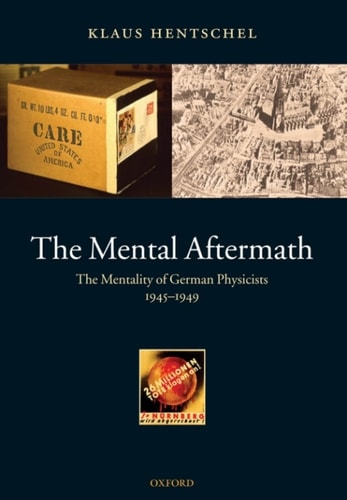
The Mental Aftermath: The Mentality of German Physicists 1945-1949
0
0
As an Amazon Associate and affiliate partner, Menrva Books earns from qualifying purchases. Learn more
Author Description
Few scientific communities have been more thoroughly studied than 20th-century German physicists. Yet their behaviour and patterns of thinking immediately after the war remains puzzling. During the first five post war years they suspended their internecine battles and a strange solidarity emerged. Former enemies were suddenly willing to exonerate each other blindly and even morally upright physicists began to write tirades against the 'denazification mischief' or the 'export of scientists'. Personal idiosyncrasies melded into a strangely uniform pattern of rejection or resistance to the Allied occupiers, with attendant repressed feelings and self-pity. Politics was once again perceived as remote, dirty business. It was feared that the least concession of guilt would bring down even more severe sanctions on their discipline. Using tools from the history of mentality, such as analysis of serial publications, these tendencies are examined. The perspective of emigré physicists, as reflected in their private letters and reports, embellish this portrait.
Menrva's Summary
THE THESIS
This work investigates the psychological and social mechanisms that led the German physics community to adopt a uniform stance of resistance and self-pity during the immediate post-war period of 1945-1949. Klaus Hentschel, a historian of science, utilizes a methodology rooted in the history of mentality to examine how a previously fractured scientific community achieved a sudden, defensive solidarity. By analyzing professional serial publications and private correspondence from emigré physicists, the author argues that this collective behavior was a strategic, albeit repressed, response to the perceived threat of Allied denazification and professional sanctions.
THE SCOPE MAP
What You Will Find
- Analysis of professional journals and serial publications from 1945-1949
- Examination of the social dynamics between German physicists and Allied occupiers
- Integration of private letters and reports from emigré scientists
- Application of the history of mentality framework to scientific communities
Scope Limits
- The study focuses specifically on the German physics community rather than broader scientific disciplines
- The analysis is confined to the immediate post-war window of 1945-1949
THE AUTHORITY PERSPECTIVE
Experts recognize this text as a significant contribution to the historiography of post-war German science, noting its precise application of mentality history to a complex political period. Readers frequently highlight the academic density of the prose, which provides a rigorous examination of how professional identity can be shaped by collective trauma and political pressure.
Page Count:
216
Publication Date:
2007-01-01
Publisher:
Oxford University Press
ISBN-10:
0191525618
ISBN-13:
9780191525612
History
Post-War
Earth Sciences
Science History
Sociology of Science
Physics
Physicists
Community Tags
Similar Books