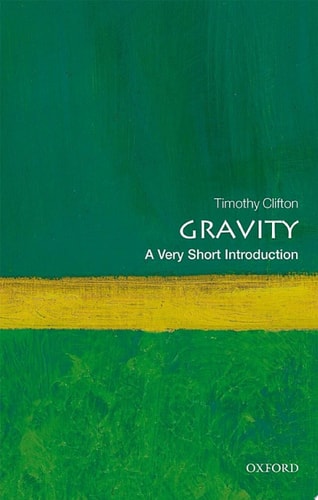
Gravity: A Very Short Introduction
0
0
As an Amazon Associate and affiliate partner, Menrva Books earns from qualifying purchases. Learn more
Author Description
Gravity is one of the four fundamental interactions that exist in nature. It also has the distinction of being the oldest, weakest, and most difficult force to quantize. Understanding gravity is not only essential for understanding the motion of objects on Earth, but also the motion of all celestial objects, and even the expansion of the Universe itself. It was the study of gravity that led Einstein to his profound realisations about the nature of space and time. Gravity is not only universal, it is also essential for understanding the behaviour of the Universe, and all astrophysical bodies within it. In this Very Short Introduction Timothy Clifton looks at the development of our understanding of gravity since the early observations of Kepler and Newtonian theory. He discusses Einstein's theory of gravity, which now supplants Newton's, showing how it allows us to understand why the frequency of light changes as it passes through a gravitational field, why GPS satellites need their clocks corrected as they orbit the Earth, and why the orbits of distant neutron stars speed up. Today, almost 100 years after Einstein published his theory of gravity, we have even detected the waves of gravitational radiation that he predicted. Clifton concludes by considering the testing and application of general relativity in astrophysics and cosmology, and looks at dark energy and efforts such as string theory to combine gravity with quantum mechanics. ABOUT THE SERIES: The Very Short Introductions series from Oxford University Press contains hundreds of titles in almost every subject area. These pocket-sized books are the perfect way to get ahead in a new subject quickly. Our expert authors combine facts, analysis, perspective, new ideas, and enthusiasm to make interesting and challenging topics highly readable.
Menrva's Summary
THE THESIS
This book investigates the fundamental nature of gravity, tracing its conceptual evolution from classical mechanics to modern general relativity. Timothy Clifton, a researcher in theoretical physics and cosmology, utilizes historical scientific milestones and contemporary astrophysical data to explain how gravity shapes the structure of the universe. The text provides a framework for understanding how gravitational theory bridges the gap between planetary motion and the quantum scale.
THE SCOPE MAP
What You Will Find
- Historical development of gravitational theory from Kepler to Newton
- Principles of Einstein's general relativity and its observational evidence
- Applications of gravity in modern technology like GPS and neutron star observation
- Theoretical explorations of dark energy and quantum gravity
Scope Limits
- The text does not provide exhaustive mathematical derivations for complex field equations
- It does not serve as a comprehensive textbook for advanced graduate-level physics
THE AUTHORITY PERSPECTIVE
Experts and readers recognize this work as an accessible entry point for those seeking a concise overview of gravitational physics. The prose is noted for its clarity, effectively distilling complex astrophysical concepts into a format suitable for non-specialists.
Page Count:
120
Publication Date:
2017-01-01
Publisher:
OUP Oxford
ISBN-10:
0191045330
ISBN-13:
9780191045332
Non-Fiction
Science
Earth Sciences
Gravity
Physics
Cosmology
Astronomy