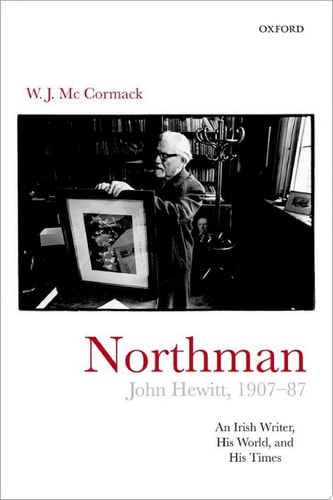
Northman: John Hewitt (1907-87): An Irish Writer, His World, and His Times
0
0
As an Amazon Associate and affiliate partner, Menrva Books earns from qualifying purchases. Learn more
Author Description
This, the first ever biography of John Hewitt, is based on archival material, both personal and literary. In many ways it is also a biography of his wife, Roberta (nee Black), whose manuscript journal is also in the public domain. To establish Hewitt's late arrival as a poet, the book opens with a chapter recounting his negotiations with a London publisher over a long period and the eventual appearance of No Rebel Word (1949). Successive chapters trace his education, courtship, literary apprenticeship, first employment as a junior gallery curator in Belfast, the political conflicts of the 1930s and then the War Years, his rejection for the post of director in Belfast's Civic Museum and Gallery, and his utopian commitment to regionalism. Appointment to the Herbert Gallery in Coventry in 1956 brought recognition and confidence. His leanings towards socialist realism came to accommodate abstract art, and he defended the sculptor Barbara Hepworth against the penny-pinching ratepayers. Throughout this two-part career, Hewitt maintained his output as poet, culminating in the Collected Poems (1968). His Irish political commitments never wavered, though he became cautious about forms of nationalism which proclaimed themselves left-wing. Roberta Hewitt's work for the Coventry Labour Party provided an outlet for her energies and her domestic frustrations. Throughout these forty years, the poetry is kept constantly in view, sometime by reference to individual pieces and their origins, and some by means of longer 'breaks for text' where more detailed criticism is practised. In 1972, the Hewitts returned to Belfast whenthe Troubles reached an ugly peak. Committed to anti-sectarianism, Hewitt withheld support from all parties, though he took an interest in trade union activity. Publishing (perhaps too much) poetry in his last decade-and-a-half, he died very much in harness.
Menrva's Summary
THE THESIS
This biography investigates the life and intellectual development of Irish poet John Hewitt, examining how his personal experiences and political commitments shaped his literary output. Author W. J. McCormack utilizes extensive archival material, including personal correspondence and the private journals of Hewitt's wife, Roberta, to construct a comprehensive portrait. The text argues that Hewitt’s identity as a poet was inextricably linked to his regionalist philosophy and his navigation of the complex political landscape of 20th-century Ireland and England. By integrating biographical narrative with critical analysis of his poetry, McCormack provides a framework for understanding Hewitt’s evolution from a junior gallery curator to a recognized literary figure.
THE SCOPE MAP
What You Will Find
- Detailed account of Hewitt’s professional career in Belfast and Coventry galleries.
- Analysis of the influence of socialist realism and regionalism on his creative work.
- Examination of the political climate in Ireland during the 1930s, the War Years, and the Troubles.
- Critical interpretation of key poems and collections, including 'No Rebel Word' and 'Collected Poems'.
- Insights into the domestic and political life of Roberta Hewitt.
Scope Limits
- The text does not provide an exhaustive bibliography of every minor publication or ephemeral piece written by Hewitt.
- The analysis focuses primarily on the intersection of his public career and private life rather than a purely aesthetic critique of his entire poetic canon.
THE AUTHORITY PERSPECTIVE
Scholars and critics recognize this work as the foundational biographical study of John Hewitt, noting its meticulous use of primary source materials. Readers frequently highlight the academic density of the prose, which serves as a comprehensive resource for those interested in the cultural and political history of 20th-century Ireland.
Page Count:
314
Publication Date:
2015-01-01
Publisher:
OUP Oxford
ISBN-10:
0191060429
ISBN-13:
9780191060427
Biography
Poetry
Irish History
English
Literary Criticism
Socialist History
English & College Success
Community Tags
Similar Books