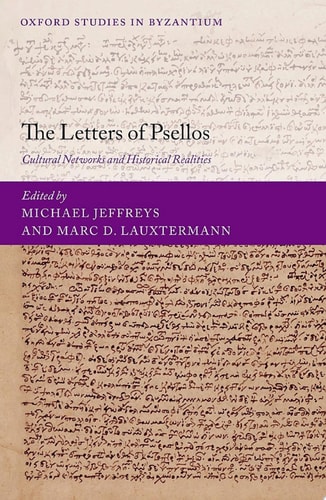
The Letters of Psellos: Cultural Networks and Historical Realities
0
0
As an Amazon Associate and affiliate partner, Menrva Books earns from qualifying purchases. Learn more
Author Description
The Letters of Psellos is the first detailed study of the correspondence of Michael Psellos, a leading Byzantine intellectual, politician, and writer of the eleventh century. Psellos' corpus of over 500 letters represents a historical source of great significance for the study of society and culture of the time: literary masterpieces in and of themselves, yet often complex and difficult to understand in their entirety, they not only rebound with subtlety and humour, but also offer invaluable information on myriad subjects ranging from the political culture of Byzantium and its civil administration to social codes, religious beliefs, and popular culture. This volume consists of two complementary parts designed to make Psellos' letters as widely accessible as possible, both to the specialist academic community and to a wider non-specialist audience. The first part contains five essays offering detailed historical and literary analyses of a considerable number of the letters across a range of different topics, including the financial management of monasteries, the friendship of Psellos and John Mauropous, and the challenges posed by Psellian irony. While the essays are supplemented by individual appendices containing the translated text of the pertinent letters, the second part of the book presents annotated summaries in English of the entirety of Psellos' correspondence, compiled over many years as part of the Prosopography of the Byzantine World project and supported by substantial excursuses and notes. The result is an engaging and accessible shortcut into these bewildering and fascinating letters and an essential resource for the study of eleventh-century Byzantine society and culture through the pen of one of its pre-eminent figures.
Menrva's Summary
THE THESIS
This volume investigates the historical and cultural significance of the correspondence of Michael Psellos, a prominent eleventh-century Byzantine intellectual and politician. The authors, Marc D. Lauxtermann and Michael Jeffreys, utilize Psellos' extensive corpus of over 500 letters to construct a framework for understanding the social, political, and religious landscape of the Byzantine Empire. By combining analytical essays with annotated summaries, the text provides a methodology for interpreting the complex irony and rhetorical strategies employed by Psellos in his private and professional communications.
THE SCOPE MAP
What You Will Find
- Detailed historical and literary analysis of Psellian correspondence.
- Annotated English summaries of the entire corpus of over 500 letters.
- Examination of eleventh-century Byzantine civil administration and social codes.
- Case studies on monastic financial management and intellectual friendships.
Scope Limits
- The text does not provide a comprehensive biography of Psellos outside the context of his correspondence.
- The volume focuses primarily on the eleventh century and does not extend analysis into later Byzantine periods.
THE AUTHORITY PERSPECTIVE
Experts recognize this volume as a critical reference for the Prosopography of the Byzantine World project, providing necessary clarity for scholars navigating Psellos' dense and often ironic prose. Readers frequently note the academic rigor of the essays, which serve to bridge the gap between specialized research and broader historical inquiry.
Page Count:
478
Publication Date:
2016-01-01
Publisher:
OUP Oxford
ISBN-10:
0191091022
ISBN-13:
9780191091025
History
Biography
Byzantine History
Literary Criticism
Ancient History
Community Tags
Similar Books