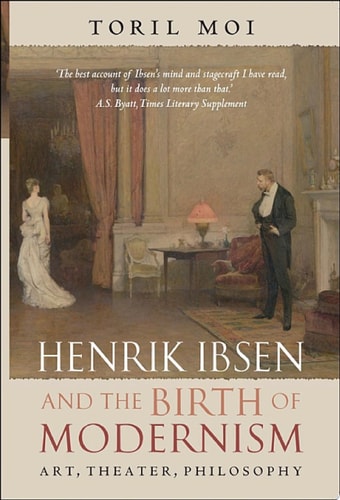
Henrik Ibsen and the Birth of Modernism: Art, Theater, Philosophy
0
0
As an Amazon Associate and affiliate partner, Menrva Books earns from qualifying purchases. Learn more
Author Description
Henrik Ibsen (1828-1906) is the founder of modern theater, and his plays are performed all over the world. Yet in spite of his unquestioned status as a classic of the stage, Ibsen is often dismissed as a boring old realist, whose plays are of interest only because they remain the gateway to modern theater. In Henrik Ibsen and the Birth of Modernism, Toril Moi makes a powerful case not just for Ibsen's modernity, but also for his modernism. Henrik Ibsen and the Birth of Modernism situates Ibsen in his cultural context, emphasizes his position as a Norwegian in European culture, and shows how important painting and other visual arts were for his aesthetic education. The book rewrites literary history, reminding modern readers that idealism was the dominant aesthetic paradigm of the nineteenth century. Modernism was born in the ruins of idealism, Moi argues, thus challenging traditional theories of the opposition between realism and modernism. By reading Ibsen's modernist plays as investigations of the fate of love in an age of skepticism, Moi shows why Ibsen still matters to us. In this book, Ibsen's plays are showed to be profoundly concerned by theater and theatricality, both on stage and in everyday life. Ibsen's unsettling explorations of women, men, and marriage here emerge as chronicles of the tension between skepticism and the everyday, and between critique and utopia in modernity. This radical new account places Ibsen in his rightful place alongside Baudelaire, Flaubert, and Manet as a founder of European modernism.
Menrva's Summary
THE THESIS
Toril Moi investigates whether Henrik Ibsen should be classified as a foundational figure of modernism rather than merely a traditional realist. Drawing on her expertise in literary theory and Scandinavian studies, Moi utilizes a rigorous analysis of Ibsen's aesthetic education, his Norwegian cultural roots, and his engagement with nineteenth-century idealism to argue that his work serves as a critical bridge to the modernist movement. She posits that Ibsen's plays function as profound inquiries into the nature of skepticism and the everyday, effectively repositioning him alongside contemporaries like Baudelaire and Flaubert.
THE SCOPE MAP
What You Will Find
- Analysis of Ibsen's aesthetic development through the lens of nineteenth-century visual arts and painting.
- A re-evaluation of the historical tension between realism and modernism.
- Examination of Ibsen's plays as philosophical investigations into love, marriage, and skepticism.
- Contextualization of Ibsen as a Norwegian artist operating within the broader European cultural sphere.
Scope Limits
- The text does not provide a comprehensive biography of Ibsen's personal life outside of his artistic and intellectual development.
- The analysis focuses primarily on the transition from idealism to modernism rather than an exhaustive survey of all theatrical adaptations of his work.
THE AUTHORITY PERSPECTIVE
Scholars and critics recognize this work as a significant intervention in Ibsen studies that successfully challenges long-standing assumptions about the playwright's aesthetic classification. Readers frequently note the academic density of the prose, which demands a high level of familiarity with literary theory and nineteenth-century European philosophy.
Page Count:
424
Publication Date:
2008-01-01
Publisher:
OUP Oxford
ISBN-10:
0191502642
ISBN-13:
9780191502644
Philosophy
Biography
English & College Success
European History
Literary Criticism
Modernism
English
Theater History
Community Tags
Similar Books