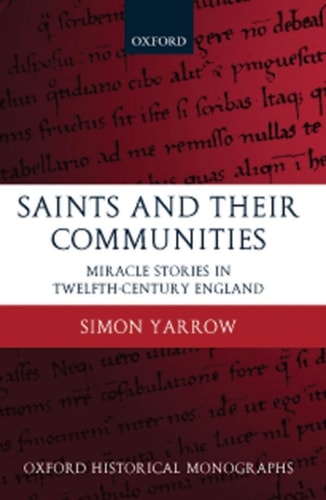
Saints and Their Communities: Miracle Stories in Twelfth-Century England
0
0
As an Amazon Associate and affiliate partner, Menrva Books earns from qualifying purchases. Learn more
Author Description
Saints and their Communities offers a new approach to the study of lay religion as evidenced in collections of miracle narratives in twelfth-century England. There are a number of problems associated with the interpretation of this hagiographical genre and an extended introduction discusses these. The first issue is the tendency to read these narratives as transparent accounts of lay religion as if it were something susceptible to static, 'ethnographic' treatment in isolation from wider social and political activities. The second issue is the challenge of explaining the miraculous as a credible part of cultural experience, without appealing to reductionist notions of a 'medieval mindset'. The third issue is the problem of how to take full account of the fact that these sources are representations of lay experience by monastic authors. The author argues that miracle narratives were the product of and helped to foster lay notions of Christian practice and identity centred on the spiritual patronage of certain enshrined saints. The six main chapters provide fully contextualized studies of selected miracle collections. Yarrow looks at when these collections were made, who wrote them, the kinds of audiences they are likely to have reached, and the messages they were intended to convey. He shows how these texts served to represent specific cults in terms that articulated the values and interests of the institutions acting as custodians of the relics; and how alongside other programmes of textual production, these collections of stories can be linked to occasions of uncertainty or need in the life of these institutions. A concluding chapter argues the case for miracle collections as evidence of the attempt by traditional monasteries to reach out to the relatively affluent peasantry, and to urban communities in society, and their rural hinterlands with offers of protection and opportunities for them to express their social status with reference to tomb-centred sanctity.
Menrva's Summary
THE THESIS
This work investigates how twelfth-century English miracle narratives functioned as complex social and institutional tools rather than simple, transparent records of medieval lay belief. Simon Yarrow, a specialist in medieval religious history, challenges the traditional ethnographic reading of hagiography by examining the power dynamics between monastic authors and the lay communities they sought to influence. He argues that these texts were strategic representations designed to foster specific identities and institutional patronage during periods of social and political uncertainty.
THE SCOPE MAP
What You Will Find
- Analysis of twelfth-century English miracle collections and their production contexts.
- A framework for interpreting hagiography as a product of institutional interest.
- Examination of the relationship between monasteries and urban or affluent rural populations.
Scope Limits
- The study does not provide a comprehensive survey of all medieval hagiography.
- It does not attempt to validate the historical veracity of the miracles themselves.
THE AUTHORITY PERSPECTIVE
Scholars recognize this monograph as a sophisticated intervention in the study of medieval religious culture, particularly for its refusal to rely on reductive concepts of a monolithic medieval mindset. Readers frequently note the academic density of the prose, which is intended for an audience of historians and researchers familiar with the nuances of ecclesiastical history.
Page Count:
258
Publication Date:
2006-01-01
Publisher:
Clarendon Press
ISBN-10:
0191515795
ISBN-13:
9780191515798
History
Cultural History
Religious History
Great Britain
Hagiography
European History
England History
Community Tags
Similar Books