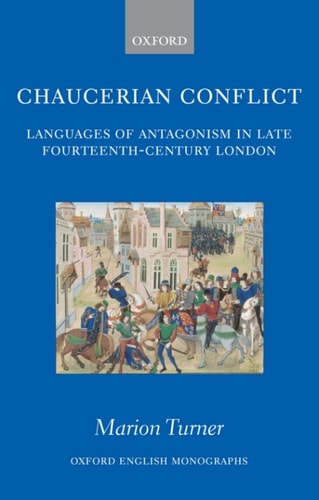
Chaucerian Conflict: Languages of Antagonism in Late Fourteenth-Century London
0
0
As an Amazon Associate and affiliate partner, Menrva Books earns from qualifying purchases. Learn more
Author Description
Chaucerian Conflict explores the textual environment of London in the 1380s and 1390s, revealing a language of betrayal, surveillance, slander, treason, rebellion, flawed idealism, and corrupted compaignyes. Taking a strongly interdisciplinary approach, it examines how discourses about social antagonism work across different kinds of texts written at this time, including Chaucer's House of Fame, Troilus and Criseyde, and Canterbury Tales, and other literary texts such as St Erkenwald, Gower's Vox clamantis, Usk's Testament of Love, and Maidstone's Concordia. Many non-literary texts are also discussed, including the Mercers' Petition, Usk's Appeal, the guild returns, judicial letters, de Mezieres's Letter to Richard II, and chronicle accounts. These were tumultuous decades in London: some of the conflicts and problems discussed include the Peasants' Revolt, the mayoral rivalries of the 1380s, the Merciless Parliament, slander legislation, and contemporary suspicion of urban associations. While contemporary texts try to hold out hope for the future, or imagine an earlier Golden Age, Chaucer's texts foreground social conflict and antagonism. Though most critics have promoted an idea of Chaucer's texts as essentially socially optimistic and congenial, Marion Turner argues that Chaucer presents a vision of a society that is inevitably divided and destructive.
Menrva's Summary
THE THESIS
This work investigates how the discourse of social antagonism and betrayal permeated the literary and non-literary texts of late fourteenth-century London. Marion Turner, a scholar of medieval literature, utilizes an interdisciplinary framework to challenge the traditional view of Chaucer as an optimistic writer. By analyzing the intersection of political instability and textual production, she argues that Chaucer’s work reflects a society defined by division, surveillance, and structural corruption.
THE SCOPE MAP
What You Will Find
- Analysis of fourteenth-century London political events including the Peasants' Revolt and the Merciless Parliament.
- Comparative study of literary works by Chaucer, Gower, Usk, and Maidstone alongside non-literary documents like the Mercers' Petition.
- Examination of linguistic patterns related to treason, slander, and urban association.
Scope Limits
- The study focuses specifically on the 1380s and 1390s in London and does not extend to broader European literary trends of the period.
- The analysis is restricted to texts that explicitly engage with themes of social conflict and does not provide a comprehensive survey of all medieval English literature.
THE AUTHORITY PERSPECTIVE
Scholars recognize this text as a significant intervention in Chaucerian studies that successfully pivots away from idealized readings of his work. Readers frequently note the academic density of the prose and the rigor with which the author connects literary motifs to specific historical grievances.
Page Count:
224
Publication Date:
2007-01-01
Publisher:
OUP Oxford
ISBN-10:
0191525936
ISBN-13:
9780191525933
History
English
English literature
English & College Success
Literary Criticism
Social History
Community Tags
Similar Books