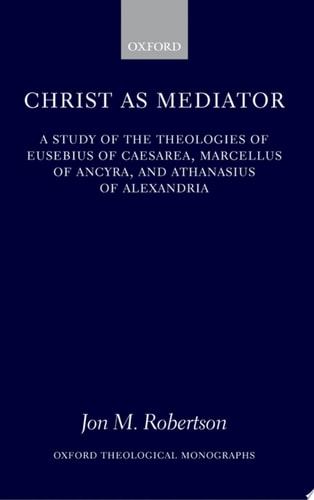
Christ as Mediator: A Study of the Theologies of Eusebius of Caesarea, Marcellus of Ancyra, and Athanasius of Alexandria
0
0
As an Amazon Associate and affiliate partner, Menrva Books earns from qualifying purchases. Learn more
Author Description
A detailed study of one theological concept (divine mediation) that was central to the Christological controversy of the early fourth century. By analysing the views of three participants at the Council of Nicaea (325), Jon M. Robertson demonstrates the variety of perspectives in a way that questions popular approaches to the period that see the controversy as having only two sides. His analysis constitutes a new approach to the early Arian controversy, as well as showing the theological backdrop of Athanasius' insight on Christ as mediator. It further demonstrates the contemporary relevance of the issue by giving an Athanasian critique of the modern Christology of Roger Haight.
Menrva's Summary
THE THESIS
This study investigates the theological concept of divine mediation as a central point of contention during the fourth-century Christological controversies. Jon M. Robertson, a scholar of early Christian thought, utilizes primary source analysis of the writings of Eusebius of Caesarea, Marcellus of Ancyra, and Athanasius of Alexandria to challenge binary interpretations of the Arian controversy. By examining these three distinct perspectives, the author reconstructs the complex theological landscape surrounding the Council of Nicaea and evaluates the historical development of Athanasian Christology.
THE SCOPE MAP
What You Will Find
- Comparative analysis of Christological frameworks from the early fourth century
- Examination of the Council of Nicaea participants' theological arguments
- A critical application of Athanasian theology to modern Christological discourse
Scope Limits
- The study does not provide a comprehensive history of the entire Arian controversy
- It does not address non-Nicene or later medieval developments in mediation theory
THE AUTHORITY PERSPECTIVE
Scholars and theologians recognize this work as a rigorous contribution to the study of early Church history and the nuances of the Arian controversy. Readers frequently note the academic density of the prose, which is intended for those with a background in patristic studies and systematic theology.
Page Count:
256
Publication Date:
2007-01-01
Publisher:
Oxford University Press
ISBN-10:
0191526517
ISBN-13:
9780191526510
Religion
Church History
Christology
Patristics
Christian History
Theology
Community Tags
Similar Books