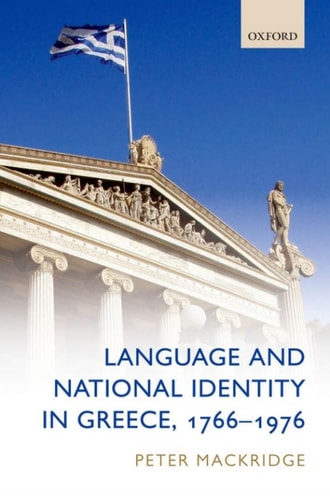
Language and National Identity in Greece, 1766-1976
0
0
As an Amazon Associate and affiliate partner, Menrva Books earns from qualifying purchases. Learn more
Author Description
This is a history of the great language controversy that has occupied and empassioned Greeks - sometimes with fatal results - for over two hundred years. It begins in the late eighteenth-century when a group of Greek intellectuals sought to develop a new, Hellenic, national identity alongside the traditional identity supplied by Orthodox Christianity. The ensuing controversy focused on the language, fuelled on the one hand by a desire to develop a form of Greek that expressed the Greeks' relationship to the ancients, and on the other by the different groups' contrasting notions of what the national image so embodied should be. The purists wanted a written language close to the ancient. The vernacularists - later known as demoticists - sought to match written language to spoken, claiming the latter to be the product of the unbroken development of Greek since the time of Homer. Peter Mackridge explores the political, social, and linguistic causes and effects of the controversy in its many manifestations. Drawing on a wide range of evidence from literature, language, history, and anthropology, he traces its effects on spoken and written varieties of Greek and shows its impact on those in use today. He describes the efforts of linguistic elites and the state to achieve language standardization and independence from languages such as Turkish, Albanian, Vlach, and Slavonic. This is a timely book. The sense of national and linguistic identity that has been inculcated into generations of Greeks since the start of the War of Independence in 1821 has, in the last 25 years, received blows from which it may not recover. Immigration from Eastern Europe and elsewhere has introduced new populations whose religions, languages, and cultures are transforming Greece into a country quite different from what it has been and to what it once aspired to be.
Menrva's Summary
THE THESIS
This book investigates the historical development of the Greek language controversy and its profound role in shaping modern Greek national identity between 1766 and 1976. Peter A. Mackridge, a scholar of modern Greek language and literature, utilizes a multidisciplinary approach to analyze how competing linguistic ideologies—specifically the tension between purist and demoticist movements—functioned as a proxy for broader political and social conflicts within the Greek state. The work argues that the struggle to standardize the Greek language was fundamentally an effort to reconcile the nation's relationship with its ancient heritage while navigating the pressures of modernization and independence.
THE SCOPE MAP
What You Will Find
- Historical analysis of the Greek language question from the late 18th century to the late 20th century.
- Examination of the ideological divide between Katharevousa (purist) and Demotic (vernacular) language movements.
- Exploration of the influence of foreign languages, including Turkish, Albanian, and Slavonic, on Greek identity formation.
- Integration of literary, historical, and anthropological evidence to contextualize linguistic shifts.
Scope Limits
- The text primarily focuses on the period ending in 1976 and does not provide an exhaustive analysis of post-1976 linguistic developments.
- While it touches on immigration, it does not provide a comprehensive sociological study of contemporary Greek demographics.
THE AUTHORITY PERSPECTIVE
Experts and historians recognize this work as a definitive account of the Greek language question, frequently citing its meticulous research and balanced treatment of complex ideological debates. Readers often note the academic density of the prose, which provides a rigorous framework for understanding the intersection of linguistics and nationalism in the Balkans.
Page Count:
432
Publication Date:
2009-01-01
Publisher:
OUP Oxford
ISBN-10:
0191550345
ISBN-13:
9780191550348
History
Linguistics
Greek language
Political Aspects
Modern Greek
English
Greece
English & College Success
Greek History
Nationalism
Community Tags
Similar Books