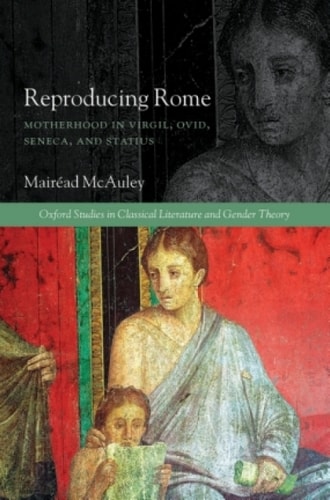
Reproducing Rome: Motherhood in Virgil, Ovid, Seneca, and Statius
0
0
As an Amazon Associate and affiliate partner, Menrva Books earns from qualifying purchases. Learn more
Author Description
In the conservative and competitive society of ancient Rome, where the law of the father (patria potestas) was supposedly absolute, motherhood took on complex aesthetic, moral, and political meanings in elite literary discourse. Reproducing Rome is a study of the representation of maternity in the Roman literature of the first century CE, a period of intense social upheaval and reorganization as Rome was transformed from a Republic to a form of hereditary monarchy under the emperor Augustus. Through a series of close readings of works by Virgil, Ovid, Seneca, and Statius, the volume scrutinizes the gender dynamics that permeate these ancient authors' language, imagery, and narrative structures. Analysing these texts 'through and for the maternal', McAuley considers to what degree their representations of motherhood reflect, construct, or subvert Roman ideals of, and anxieties about, family, gender roles, and reproduction. The volume also explores the extent to which these representations distort or displace concerns about fatherhood or other relations of power in Augustan and post-Augustan Rome. Keeping the ancient literary and historical context in view, the volume conducts a dialogue between these ancient male authors and modern feminist theorists-from Klein to Irigaray, Kristeva to Cavarero-to consider the relationship between motherhood as symbol and how a maternal subjectivity is suggested, developed, or suppressed by the authors. Readers are encouraged to consider the problems and possibilities of reading the maternal in these ancient texts, and to explore the unique site the maternal occupies in pre-modern discourses underpinning Western culture.
Menrva's Summary
THE THESIS
This volume investigates how the representation of motherhood in first-century CE Roman literature functions as a site for negotiating anxieties regarding power, gender roles, and the transition from Republic to hereditary monarchy. Mairéad McAuley, a scholar of classical literature, utilizes a framework that synthesizes close textual analysis of Virgil, Ovid, Seneca, and Statius with modern feminist theory. The work argues that maternal imagery in these texts serves to both reflect and subvert the rigid patriarchal structures of the era, specifically the concept of patria potestas.
THE SCOPE MAP
What You Will Find
- Analysis of maternal representations in the works of Virgil, Ovid, Seneca, and Statius.
- A theoretical dialogue between ancient literary texts and modern feminist theorists including Klein, Irigaray, Kristeva, and Cavarero.
- Examination of the intersection between political shifts in the Augustan era and domestic gender dynamics.
Scope Limits
- The study is restricted to elite literary discourse of the first century CE.
- It does not provide a comprehensive social history of actual Roman motherhood, focusing instead on literary and symbolic representations.
THE AUTHORITY PERSPECTIVE
Scholars in the field of classical studies recognize this work as a significant contribution to the intersection of gender theory and Roman literature. Readers frequently note the academic density of the prose and the sophisticated application of psychoanalytic and feminist frameworks to ancient texts.
Page Count:
448
Publication Date:
2015-01-01
Publisher:
OUP Oxford
ISBN-10:
0191634204
ISBN-13:
9780191634208
Literary Criticism
Virgil
English
English & College Success
Ancient History
Criticism history
Roman
Gender Theory
Feminist Theory
Community Tags
Similar Books