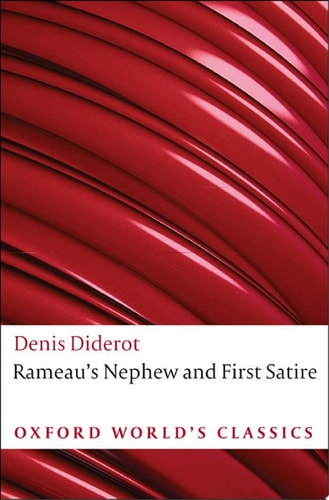
Rameau's Nephew and First Satire
0
0
As an Amazon Associate and affiliate partner, Menrva Books earns from qualifying purchases. Learn more
Author Description
'unless you know everything, you really know nothing' Diderot's brilliant and witty dialogue begins with a chance encounter in a Paris café between two acquaintances. Their talk ranges broadly across art, music, education, and the contemporary scene, as the nephew of composer Rameau, amoral and bohemian, alternately shocks and amuses the moral, bourgeois figure of his interlocutor. Exuberant and highly entertaining, the dialogue exposes the corruption of society in Diderot's characteristic philosophical exploration. The debates of the French Enlightenment speak to us vividly in this sparkling new translation, which also includes the First Satire, a related work that provides the context for Rameau's Nephew, Diderot's 'second satire'.
Menrva's Summary
THE PULSE
A chance encounter in a Parisian café triggers a wide-ranging philosophical debate between a conventional moralist and a bohemian provocateur.
The protagonist, an interlocutor representing bourgeois morality, engages in a dialectical struggle with the nephew of the composer Rameau, a figure defined by his amorality and social non-conformity. Their conversation serves as a vehicle for Diderot to examine the tensions between individual desire and social expectation. The narrative framework utilizes a dialogue-heavy structure that moves fluidly between art, music, and the corruption of contemporary society. The physical setting of the café acts as a microcosm for the broader intellectual landscape of the French Enlightenment.
INSIDE THE PAGES
- Socratic-style dialogue format
- Philosophical inquiry into morality and social norms
- Satirical characterization of the bohemian archetype
- Exploration of aesthetic and musical theory
- Critique of 18th-century French social structures
- Use of irony and wit to challenge conventional wisdom
- Inclusion of the First Satire for contextual depth
- Non-linear thematic progression
THE COLLECTIVE ECHO
Readers and critics frequently highlight the work's enduring relevance due to its sharp wit and unconventional structure. Discussion often centers on the ambiguity of the two primary voices, as Diderot avoids providing a clear moral victor in the debate. Many observers appreciate the balance between the intellectual density of the philosophical arguments and the lively, often chaotic personality of the nephew. The text is widely regarded as a foundational example of the dialogue form, with scholars noting its effectiveness in exposing the hypocrisies of its time. Readers often find the interplay between the two characters to be both intellectually stimulating and highly entertaining.
Page Count:
175
Publication Date:
2006-01-01
Publisher:
OUP Oxford
ISBN-10:
0191604771
ISBN-13:
9780191604775
Philosophy
Classics
Satire
Public Health
Social Sciences - Sociology - DemographyPopulation
French literature
Dialogue
Enlightenment
Community Tags
Similar Books