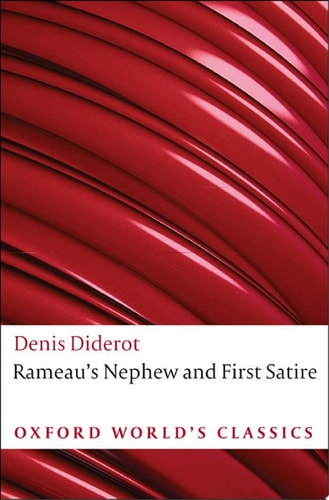
Rameau's Nephew and First Satire
0
0
As an Amazon Associate and affiliate partner, Menrva Books earns from qualifying purchases. Learn more
Author Description
In his brilliant and witty dialogue, Denis Diderot invents a chance encounter in a Paris café between two acquaintances. Their talk ranges broadly across art, music, education, and the contemporary scene, as the nephew of composer Rameau, amoral and bohemian, alternately shocks and amuses the moral, bourgeois figure of his interlocutor. Exuberant and highly entertaining, the dialogue exposes the corruption of society in Diderot's characteristic philosophical exploration.The debates of the French Enlightenment speak to us vividly in this sparkling new translation, which also includes the only English translation of First Satire, a related work that provides the context for Rameau's Nephew, Diderot's 'second satire.' Edited by distinguished translator Margaret Mauldon, with lively introduction and notes by Nicholas Cronk, the edition includes, for the first time in English, extracts from Goethe's commentary on this seminal Enlightenment work. It will prove a valuable addition to the library to any lover of French literature.About the Series: For over 100 years Oxford World's Classics has made available the broadest spectrum of literature from around the globe. Each affordable volume reflects Oxford's commitment to scholarship, providing the most accurate text plus a wealth of other valuable features, including expert introductions by leading authorities, voluminous notes to clarify the text, up-to-date bibliographies for further study, and much more.
Menrva's Summary
THE PULSE
A chance encounter in a Parisian café triggers a sprawling, philosophical debate between a conventional moralist and a bohemian provocateur. The narrative follows the interaction between the narrator and the nephew of the composer Jean-Philippe Rameau, who serves as a chaotic foil to the bourgeois sensibilities of his companion. Through this dialogue, Diderot explores the tensions between social conformity and individual authenticity, utilizing the café setting as a microcosm for the broader corruption of 18th-century French society. The work functions as a non-linear, conversational exploration of ethics, art, and the nature of genius.
INSIDE THE PAGES
- Socratic dialogue structure
- Satirical commentary on Enlightenment social norms
- Exploration of moral relativism versus bourgeois ethics
- Philosophical discourse on music and aesthetics
- Character-driven narrative focused on personality contrast
- Inclusion of the related work First Satire
- Historical context provided by scholarly introduction and notes
- Integration of Goethe's critical commentary
THE COLLECTIVE ECHO
Readers and critics frequently highlight the work's sharp wit and the dynamic tension between the two primary characters. Discussion often centers on the nephew's role as a transgressive figure who challenges the rigid social structures of the era. Scholars emphasize the text's importance in understanding the intellectual climate of the French Enlightenment and Diderot's unique approach to philosophical fiction. The pacing is noted for its conversational fluidity, which allows for complex ideas to be presented in an accessible and engaging manner.
Page Count:
139
Publication Date:
2009-03-15
Publisher:
Oxford University Press
ISBN-10:
0199539995
ISBN-13:
9780199539994
Classics
Philosophy
Satire
French literature
Dialogue
Enlightenment
Community Tags
Other Editions(3)

Similar Books