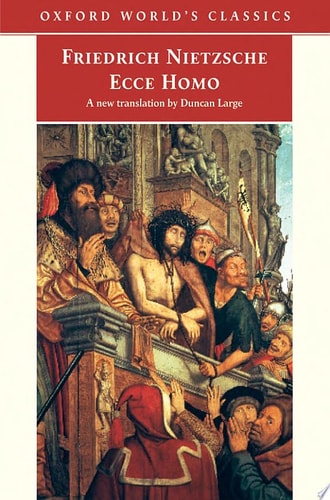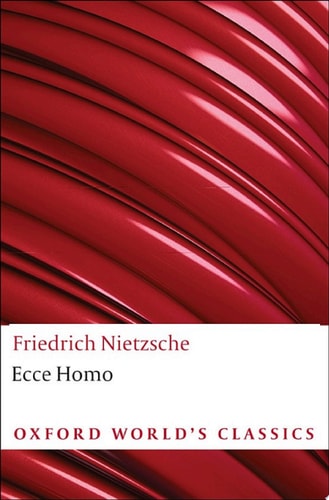
Ecce Homo: How To Become What You Are
0
0
As an Amazon Associate and affiliate partner, Menrva Books earns from qualifying purchases. Learn more
Author Description
'I am not a man, I am dynamite.' Ecce Homo is an autobiography like no other. Deliberately provocative, Nietzsche subverts the conventions of the genre and pushes his philosophical positions to combative extremes, constructing a genius-hero whose life is a chronicle of incessant self-overcoming. Written in 1888, a few weeks before his descent into madness, the book sub-titled 'How To Become What You Are' passes under review all Nietzsche's previous works so that we, his 'posthumous' readers, can finally understand him aright, on his own terms. He reaches final reckonings with his many enemies - Richard Wagner, German nationalism, 'modern men' in general - and above all Christianity, proclaiming himself the Antichrist. Ecce Homo is the summation of an extraordinary philosophical career, a last great testament to Nietzsche's will. ABOUT THE SERIES: For over 100 years Oxford World's Classics has made available the widest range of literature from around the globe. Each affordable volume reflects Oxford's commitment to scholarship, providing the most accurate text plus a wealth of other valuable features, including expert introductions by leading authorities, helpful notes to clarify the text, up-to-date bibliographies for further study, and much more.
Menrva's Summary
THE THESIS
How does a philosopher construct a final, definitive account of his own intellectual development and personal identity while facing the collapse of his mental health? Friedrich Nietzsche, writing in the final weeks of his sanity, utilizes this autobiographical work to synthesize his previous philosophical contributions and settle scores with his cultural and ideological adversaries. The text serves as a retrospective framework, positioning his life as a continuous process of self-overcoming and re-evaluating his legacy for future readers.
THE SCOPE MAP
What You Will Find
- A retrospective analysis of Nietzsche's major published works.
- Polemical critiques of figures such as Richard Wagner and the prevailing German nationalism of the era.
- A philosophical justification for his rejection of Christian morality.
Scope Limits
- The text does not provide a standard chronological biography of his early life.
- It lacks objective distance, as the narrative is intentionally provocative and self-mythologizing.
THE AUTHORITY PERSPECTIVE
Scholars and readers frequently note the intense, combative nature of the prose, which reflects the author's deteriorating mental state during the period of composition. Experts highlight this text as a critical, albeit highly subjective, primary source for understanding the final evolution of Nietzsche's philosophical project.
Page Count:
176
Publication Date:
2007-01-01
Publisher:
OUP Oxford
ISBN-10:
0191605220
ISBN-13:
9780191605222
Non-Fiction
Autobiography
Philosophy
History & Surveys
19th Century
Existentialism