
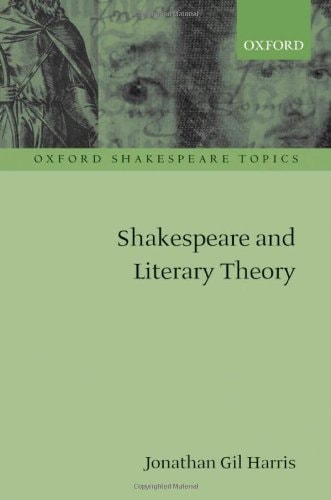
Shakespeare and Literary Theory
0
0
As an Amazon Associate and affiliate partner, Menrva Books earns from qualifying purchases. Learn more
Author Description
OXFORD SHAKESPEARE TOPICS General Editors: Peter Holland and Stanley Wells Oxford Shakespeare Topics provide students and teachers with short books on important aspects of Shakespeare criticism and scholarship. Each book is written by an authority in its field, and combines accessible style with original discussion of its subject. How is it that the British literary critic Terry Eagleton can say that 'it is difficult to read Shakespeare without feeling that he was almost certainly familiar with the writings of Hegel, Marx, Nietzsche, Freud, Wittgenstein and Derrida', or that the Slovenian psychoanalytic theorist Slavoj %Zi%zek can observe that 'Shakespeare without doubt had read Lacan'? Shakespeare and Literary Theory argues that literary theory is less an external set of ideas anachronistically imposed on Shakespeare's texts than a mode - or several modes - of critical reflection inspired by, and emerging from, his writing. These modes together constitute what we might call 'Shakespearian theory': theory that is not just about Shakespeare but also derives its energy from Shakespeare. To name just a few examples: Karl Marx was an avid reader of Shakespeare and used Timon of Athens to illustrate aspects of his economic theory; psychoanalytic theorists from Sigmund Freud to Jacques Lacan have explained some of their most axiomatic positions with reference to Hamlet; Michel Foucault's early theoretical writing on dreams and madness returns repeatedly to Macbeth; Jacques Derrida's deconstructive philosophy is articulated in dialogue with Shakespeare's plays, including Romeo and Juliet; French feminism's best-known essay is Hélène Cixous's meditation on Antony and Cleopatra; certain strands of queer theory derive their impetus from Eve Kosofsky Sedgwick's reading of the Sonnets; Gilles Deleuze alights on Richard III as an exemplary instance of his theory of the war machine; and postcolonial theory owes a large debt to Aimé Césaire's revision of The Tempest.
Menrva's Summary
THE THESIS
This book investigates the reciprocal relationship between Shakespeare's works and modern literary theory, questioning whether theory is an external imposition or an inherent reflection of the plays. Jonathan Gil Harris, a scholar of early modern literature, argues that Shakespeare's texts serve as a foundational energy source for critical frameworks. He posits that major theoretical movements—including Marxism, psychoanalysis, and postcolonialism—often derive their core concepts directly from their engagement with Shakespearean drama.
THE SCOPE MAP
What You Will Find
- Analysis of Shakespeare's influence on Marx, Freud, Lacan, Foucault, and Derrida.
- Examination of specific plays including Timon of Athens, Hamlet, Macbeth, and The Tempest.
- Exploration of diverse theoretical lenses such as queer theory, French feminism, and postcolonialism.
Scope Limits
- The text does not provide a comprehensive history of all literary theory movements.
- It does not offer a line-by-line analysis of every Shakespearean play.
THE AUTHORITY PERSPECTIVE
Scholars and students frequently identify this work as a vital resource for understanding the intersection of canonical literature and contemporary critical thought. Experts highlight the author's ability to synthesize complex philosophical arguments into a format accessible for academic study.
Page Count:
244
Publication Date:
2010-01-01
Publisher:
OUP Oxford
ISBN-10:
0191614416
ISBN-13:
9780191614415
Philosophy
Academic
English & College Success
Literary theory
Literary Criticism
English
Community Tags
Other Editions(4)
Similar Books
Reader Comments
Share Your Thoughts
No comments yet. Be the first to share your thoughts!