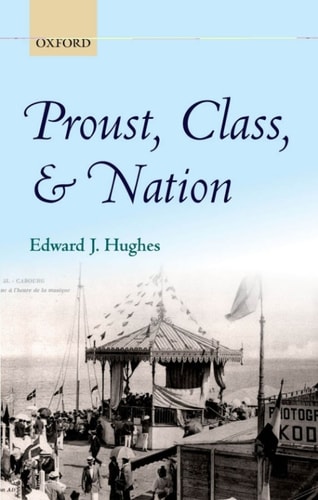
Proust, Class, and Nation
0
0
As an Amazon Associate and affiliate partner, Menrva Books earns from qualifying purchases. Learn more
Author Description
Writing in 1927, Julien Benda described France as being afflicted by the twin scourges of narrow, class-based politics and rabid nationalism. He nevertheless identified Marcel Proust (who had died in 1922) as a writer who had refused to embrace the ideological narrowness of his age. Edward J. Hughes seeks to assess how Proust and his novel A la recherche du temps perdu might be understood in relation to issues of class and nation. A la recherche was produced in momentous times. As an extended textual construction, first conceived of in 1908 and the last tranche of which appeared posthumously almost two decades later, it was assembled against a backdrop of major historical events: pre-war tensions in the wake of the Dreyfus Affair and the Separation of Church and State (issues on which Proust had campaigned publicly); the First World War and the atmosphere of narrow nationalism and Germanophobia which the conflict generated; and the continuing polarization in class politics in the years after the First World War. These all find echoes in A la recherche and Hughes establishes how the exposure given to questions of class and nation needs to be understood historically. He demonstrates that the frequently entrenched positions of Proust's contemporaries at times square with the language and images of social conservativism to be found in A la recherche. Yet alongside that, Hughes unearths evidence that points to Proust as a free-floating, often playful, iconoclast and radical commentator who, as Theodor Adorno observed, resisted bourgeois compartmentalization.
Menrva's Summary
THE THESIS
This work investigates how Marcel Proust’s A la recherche du temps perdu functions as a critical engagement with the shifting dynamics of class and nationalism in early twentieth-century France. Edward J. Hughes, a scholar of French literature, utilizes historical context and textual analysis to examine the tension between Proust’s personal political involvement and the ideological currents of his era. By situating the novel within the specific climate of the Dreyfus Affair and the First World War, the author argues that Proust’s writing simultaneously reflects and subverts the social conservatism of his contemporaries.
THE SCOPE MAP
What You Will Find
- Analysis of the Dreyfus Affair and its influence on Proust’s narrative construction.
- Examination of the impact of the First World War and rising Germanophobia on the text.
- Discussion of the polarization of class politics in post-war France.
- Comparative study of Proust’s work against the observations of critics like Julien Benda and Theodor Adorno.
Scope Limits
- The analysis is primarily restricted to the relationship between the novel and French socio-political history.
- The text does not provide a comprehensive biography of Proust, focusing instead on his role as a political commentator.
THE AUTHORITY PERSPECTIVE
Scholars recognize this text as a significant contribution to the historical contextualization of Proust’s major work. Readers frequently note the academic density of the prose and the author's rigorous approach to reconciling the novel's aesthetic qualities with its political undercurrents.
Page Count:
328
Publication Date:
2011-01-01
Publisher:
Oxford University Press
ISBN-10:
0191619477
ISBN-13:
9780191619472
History
Literary Criticism
English
French literature
English & College Success
Politics & Government
France history
Community Tags
Similar Books