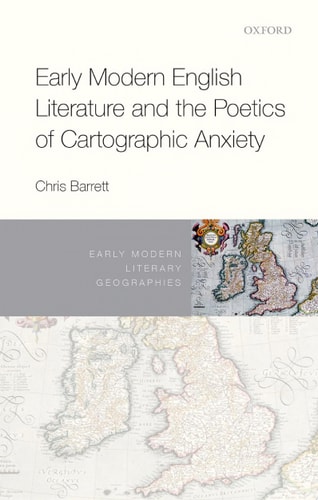
Early Modern English Literature and the Poetics of Cartographic Anxiety
0
0
As an Amazon Associate and affiliate partner, Menrva Books earns from qualifying purchases. Learn more
Author Description
The Cartographic Revolution In The Renaissance Made Maps Newly Precise, Newly Affordable, And Newly Ubiquitous. In Sixteenth-century Britain, Cartographic Materials Went From Rarity To Household Décor Within A Single Lifetime, And They Delighted, Inspired, And Fascinated People Across The Socioeconomic Spectrum. At The Same Time, They Also Unsettled, Upset, Disturbed, And Sometimes Angered Their Early Modern Readers. Early Modern English Literature And The Poetics Of Cartographic Anxiety Is The First Monograph Dedicated To Recovering The Shadow History Of The Many Anxieties Provoked By Early Modern Maps And Mapping In The Sixteenth And Seventeenth Centuries. A Product Of A Military Arms Race, Often Deployed For Security And Surveillance Purposes, And Fundamentally Distortive Of Their Subjects, Maps Provoked Suspicion, Unease, And Even Hostility In Early Modern Britain (in Ways Not Dissimilar From The Anxieties Provoked By Global Positioning-enabled Digital Mapping In The Twenty-first Century). At The Same Time, Writers Saw In The Resistance To Cartographic Logics And Strategies The Opportunity To Rethink The Way Literature Represents Space—and Everything Else. This Volume Explores Three Major Poems Of The Period—edmund Spenser's The Faerie Queene (1590, 1596), Michael Drayton's Poly-olbion (1612, 1622), And John Milton's Paradise Lost (1667, 1674)—in Terms Of Their Vexed And Vexing Relationships With Cartographic Materials, And Shows How The Productive Protest Staged By These Texts Redefined Concepts Of Allegory, Description, Personification, Bibliographic Materiality, Narrative, Temporality, Analogy, And Other Elemental Components Of Literary Representations.
Menrva's Summary
THE THESIS
This book investigates how the proliferation of cartographic materials in early modern Britain generated widespread cultural anxiety and how literary authors utilized this tension to reshape representational strategies. Chris Barrett, a scholar of early modern literature, examines the intersection of sixteenth and seventeenth-century mapping technologies with the period's major poetic works. By analyzing the military and surveillance origins of maps, the author argues that writers like Spenser, Drayton, and Milton engaged in a productive resistance to cartographic logic to redefine literary concepts such as allegory and narrative.
THE SCOPE MAP
What You Will Find
- Analysis of the cultural impact of the cartographic revolution in sixteenth and seventeenth-century Britain.
- Examination of the relationship between surveillance, military mapping, and literary production.
- Close readings of Edmund Spenser's The Faerie Queene, Michael Drayton's Poly-Olbion, and John Milton's Paradise Lost.
- Theoretical frameworks for understanding the intersection of bibliographic materiality and spatial representation.
Scope Limits
- The study focuses primarily on three major poetic works rather than a comprehensive survey of all early modern literature.
- The analysis is limited to the British context and does not provide an exhaustive global history of cartography.
THE AUTHORITY PERSPECTIVE
Scholars recognize this monograph as a significant contribution to the study of early modern spatiality and the history of the book. Readers frequently note the academic rigor of the prose and the author's ability to bridge the gap between historical cartographic practices and literary theory.
Page Count:
256
Publication Date:
2018-01-01
Publisher:
Oxford University Press
ISBN-10:
0192548824
ISBN-13:
9780192548825
Science History
Early Modern
Cartography
Literary Criticism
Renaissance
Cultural History
Community Tags
Other Editions(3)

Similar Books


Reader Comments
Share Your Thoughts
No comments yet. Be the first to share your thoughts!