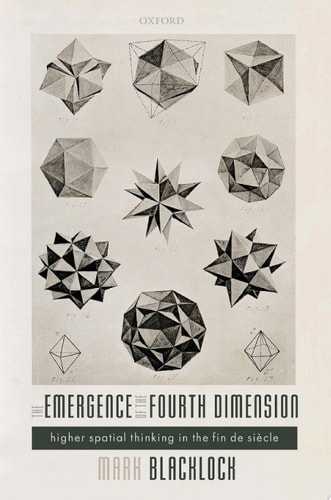
The Emergence of the Fourth Dimension: Higher Spatial Thinking in the Fin de Siècle
0
0
As an Amazon Associate and affiliate partner, Menrva Books earns from qualifying purchases. Learn more
Author Description
The Emergence of the Fourth Dimension describes the development and proliferation of the idea of higher dimensional space in the late nineteenth- and early twentieth-centuries. An idea from mathematics that was appropriated by occultist thought, it emerged in the fin de siècle as a staple of genre fiction and influenced a number of important Modernist writers and artists. Providing a context for thinking of space in dimensional terms, the volume describes an active interplay between self-fashioning disciplines and a key moment in the popularisation of science. It offers new research into spiritualism and the Theosophical Society and studies a series of curious hybrid texts. Examining works by Joseph Conrad, Ford Madox Ford, H.G. Wells, Henry James, H. P. Lovecraft, and others, the volume explores how new theories of the possibilities of time and space influenced fiction writers of the period, and how literature shaped, and was in turn shaped by, the reconfiguration of imaginative space occasioned by the n-dimensional turn. A timely study of the interplay between philosophy, literature, culture, and mathematics, it offers a rich resource for readers interested in nineteenth century literature, Modernist studies, science fiction, and gothic scholarship.
Menrva's Summary
THE THESIS
This volume investigates how the mathematical concept of the fourth dimension permeated late nineteenth- and early twentieth-century culture, influencing both scientific discourse and imaginative literature. Mark Blacklock, a scholar of literature and science, synthesizes archival research into spiritualism, the Theosophical Society, and mathematical history to argue that the n-dimensional turn functioned as a bridge between rigorous scientific inquiry and occultist speculation. He demonstrates how this conceptual shift reconfigured the imaginative boundaries of space and time for Modernist writers.
THE SCOPE MAP
What You Will Find
- Analysis of the intersection between mathematics, spiritualism, and Modernist literature
- Examination of hybrid texts by authors including H.G. Wells, Joseph Conrad, and H.P. Lovecraft
- Historical context regarding the popularization of science during the fin de siècle
- Research into the influence of the Theosophical Society on spatial theory
Scope Limits
- The study does not provide a comprehensive history of pure mathematics or non-Euclidean geometry
- It does not cover the impact of the fourth dimension on post-1945 literature or contemporary physics
THE AUTHORITY PERSPECTIVE
Scholars and critics identify this work as a significant contribution to the study of the relationship between science and literature during the Modernist period. Readers frequently note the academic density of the prose, which provides a rigorous framework for understanding how abstract mathematical concepts shaped cultural and artistic production.
Page Count:
245
Publication Date:
2018-01-01
Publisher:
OUP Oxford
ISBN-10:
0192551884
ISBN-13:
9780192551887
Philosophy
History
19th Century
Indigenous
Literary Criticism
Science History
Community Tags
Similar Books