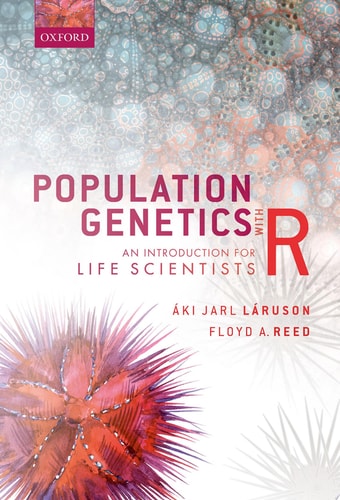
Population Genetics with R: An Introduction for Life Scientists
0
0
As an Amazon Associate and affiliate partner, Menrva Books earns from qualifying purchases. Learn more
Author Description
Population genetics is an inherently quantitative discipline, yet often focuses upon abstract concepts which can be difficult to conceptualize and appropriately visualize at first glance. This book focuses on applying the hugely popular R software specifically to the field, offering an accessible, step-by-step guide to tackling the challenges of achieving effective data interpretation and summary. The authors adopt an engaging "learning by doing" approach that will enable readers to develop an intuitive understanding of key population genetics concepts through the use of R. Beginning with the groundwork of installing and using R (including CRAN and the RStudio IDE), the book works through the use of basic commands for data manipulation. An introduction to basic terminology in population genetics follows, clearly explaining how these fundamental assumptions can provide insights and form basic inferences for real populations. The focus then moves onto statistical tests including writing and running algorithms as functions. Subsequent chapters examine genetic variation, adaptation, and natural selection as well as different approaches to population differences. Importantly, the accompanying set of practical exercises demonstrate that implementing all of these concepts via programming can actually help greatly in understanding them, even if they may at first seem insurmountably complex. Finally, this accessible textbook points the way forwards to other key concepts that are important to understanding modern day population genetics research (in particular coalescent theory) and offers the reader useful launching points for further learning. Population Genetics with R is aimed at students ranging from undergraduate to postgraduate level in the fields of population genetics, ecology, evolutionary biology, conservation genetics, computational biology, and biostatistics.
Menrva's Summary
THE THESIS
This book investigates how the R programming language can be utilized to bridge the gap between abstract population genetics theory and practical data analysis. The authors, Áki Jarl Láruson and Floyd Allan Reed, leverage their expertise to provide a structured, hands-on framework for life scientists. By integrating statistical programming with core genetic concepts, the text argues that computational implementation is the most effective method for achieving an intuitive grasp of complex evolutionary models.
THE SCOPE MAP
What You Will Find
- Step-by-step installation and configuration of R and RStudio
- Fundamental data manipulation techniques for biological datasets
- Algorithms for statistical testing in population genetics
- Analysis of genetic variation, natural selection, and adaptation
- Practical exercises designed to reinforce theoretical concepts
Scope Limits
- Does not provide an exhaustive survey of advanced coalescent theory
- Does not serve as a comprehensive manual for general R programming outside of biological applications
THE AUTHORITY PERSPECTIVE
Experts and students identify this text as a practical, accessible entry point for those transitioning from theoretical biology to computational research. Readers frequently note that the book successfully demystifies complex statistical concepts through its consistent focus on applied programming exercises.
Page Count:
224
Publication Date:
2021-01-01
Publisher:
OUP Oxford
ISBN-10:
0192565036
ISBN-13:
9780192565037
Science
R Programming
Statistics
Genetics
Programming
Evolutionary Biology
Community Tags
Similar Books