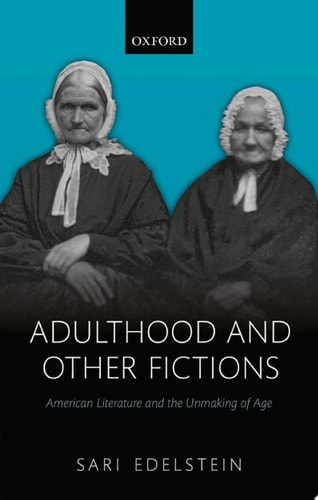
Adulthood and Other Fictions: American Literature and the Unmaking of Age
0
0
As an Amazon Associate and affiliate partner, Menrva Books earns from qualifying purchases. Learn more
Author Description
While the field of childhood studies has blossomed in recent years, few scholars have taken up the question of age more broadly as a lens for reading American literature. Adulthood and Other Fictions shows how a diverse array of nineteenth-century writers, thinkers, and artists responded to the rise of chronological age in social and political life. Over the course of the century, age was added to the census; schools were organized around age groups; birthday cards were mass-produced; geriatrics became a medical specialty. Adulthood and Other Fictions reads American literature as a rich, critical account of this modern culture of age, and it examines how our most well-known writers registered—and often resisted—age expectations, particularly as they applied to women and people of color. More than simply adding age to the list of identity categories that have become de rigueur sites of scholarly attention, Adulthood and Other Fictions argues that these other measures of social location (race, gender, sexuality, class) are largely legible through the seemingly more natural and essential identity defined by age. That is, longstanding cultural ideals about maturity and development anchor ideologies of heterosexuality, race, nationalism, and capitalism, and in this sense, age rhetoric serves as one of our most pervasive disciplinary discourses. Writers including Louisa May Alcott, Frederick Douglass, and Henry James anticipated the ageism of our moment, but they also recognized how age norms both structure and limit the lives of individuals at all points on the age continuum. Ultimately, the volume argues for an intersectional understanding of age that challenges the celebration of independence and autonomy imbricated in US fantasies of adulthood and in American identity itself.
Menrva's Summary
THE THESIS
How does the rise of chronological age as a social and political construct in the nineteenth century inform the development of American literary identity and disciplinary discourse? Sari Edelstein, an associate professor of English, utilizes a historical and critical framework to examine how nineteenth-century authors navigated the increasing institutionalization of age. She argues that age functions as a foundational identity category that intersects with and clarifies other social markers such as race, gender, and class. By analyzing the works of prominent writers, the text demonstrates that age norms were not merely biological markers but were actively used to structure social hierarchies and national ideologies.
THE SCOPE MAP
What You Will Find
- Analysis of nineteenth-century social shifts including the census, school organization, and the medicalization of aging.
- Literary readings of authors including Louisa May Alcott, Frederick Douglass, and Henry James.
- An intersectional framework connecting age rhetoric to capitalism, nationalism, and heteronormativity.
Scope Limits
- The study focuses primarily on nineteenth-century American literature and does not provide a comprehensive history of aging across all global cultures or time periods.
THE AUTHORITY PERSPECTIVE
Scholars in the field of American literary studies recognize this work as a significant contribution to the intersection of age studies and identity politics. Readers frequently note the academic density of the prose and the author's ability to synthesize historical data with close literary analysis.
Page Count:
213
Publication Date:
2018-01-01
Publisher:
OUP Oxford
ISBN-10:
0192567896
ISBN-13:
9780192567895
Sociology
American
History of Childhood
Gender Studies
Literary Criticism
English & College Success
United States
English
Community Tags
Similar Books