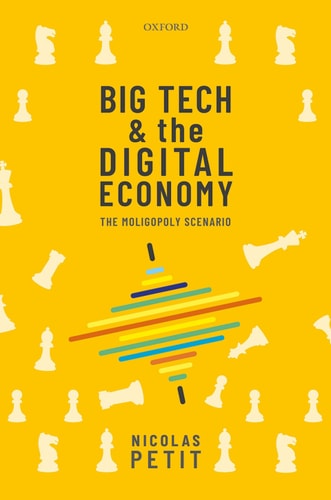
Big Tech and the Digital Economy: The Moligopoly Scenario
0
0
As an Amazon Associate and affiliate partner, Menrva Books earns from qualifying purchases. Learn more
Author Description
This book asks a simple question: are the tech giants monopolies? In the current environment of suspicion towards the major technology companies as a result of concerns about their power and influence, it has become commonplace to talk of Google, Facebook, Amazon, Apple, Microsoft, or Netflix as the modern day version of the 19th century trusts. In turn, the tech giants are vilified for a whole range of monopoly harms towards consumers, workers and even the democratic process. In the US and the EU, antitrust, and regulatory reform is on the way. Using economics, business and management science as well legal reasoning, this book offers a new perspective on big tech. It builds a theory of "moligopoly". The theory advances that the tech giants, or at least some of them, coexist both as monopolies and oligopoly firms that compete against each other in an environment of substantial uncertainty and economic dynamism. With this, the book assesses ongoing antitrust and regulatory policy efforts. It demonstrates that it is counterproductive to pursue policies that introduce more rivalry in moligopoly markets subject to technological discontinuities. And that non-economic harms like privacy violations, fake news, or hate speech are difficult issues that belong to the realm of regulation, not antimonopoly remediation.
Menrva's Summary
THE THESIS
This book investigates whether major technology companies function as traditional monopolies or if they operate under a distinct economic framework. Nicolas Petit, a professor of law and expert in competition policy, utilizes a multidisciplinary approach combining economics, management science, and legal analysis to evaluate the market behavior of firms like Google, Amazon, and Apple. He proposes the theory of "moligopoly," arguing that these entities exist simultaneously as monopolies and oligopolies within highly dynamic, uncertain environments, suggesting that current regulatory approaches may be fundamentally misaligned with these market realities.
THE SCOPE MAP
What You Will Find
- A theoretical framework defining the "moligopoly" market structure.
- Analysis of antitrust and regulatory policy efforts in both the US and the EU.
- Evaluation of the distinction between economic market power and non-economic societal harms.
Scope Limits
- The book does not provide a comprehensive history of every individual tech firm mentioned.
- It does not offer a manual for corporate compliance or specific legal defense strategies.
THE AUTHORITY PERSPECTIVE
Experts in competition law and economics frequently cite this work for its nuanced challenge to conventional antitrust narratives regarding big tech. Readers often note the academic density of the prose, which requires a foundational understanding of economic theory to fully grasp the author's arguments.
Page Count:
313
Publication Date:
2020-01-01
Publisher:
OUP Oxford
ISBN-10:
0192574728
ISBN-13:
9780192574725
Economics
Public Policy
Business strategy
Professional Career & Trade
Antitrust Law
Technology
Community Tags
Similar Books