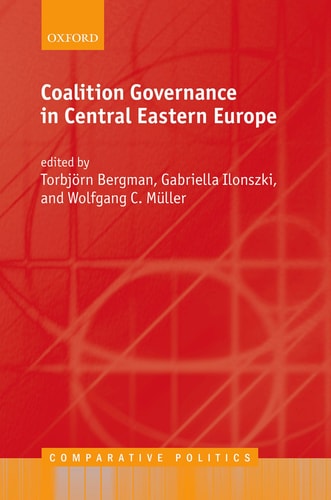
Coalition Governance in Central Eastern Europe
0
0
As an Amazon Associate and affiliate partner, Menrva Books earns from qualifying purchases. Learn more
Author Description
Coalition government among different political parties is the way most European democracies are governed. Traditionally, the study of coalition politics has been focused on Western Europe. Coalition governance in Central Eastern Europe brings the study of the full coalition life-cycle to a region that has undergone tremendous political transformation, but which has not been studied from this perspective. The volume covers Bulgaria, Estonia, the Czech Republic, Latvia, Lithuania, Hungary, Poland, Romania, Slovakia, and Slovenia. It provides information and analyses of the coalition life-cycle, from pre-electoral alliances to coalition formation and portfolio distribution, governing in coalitions, the stages that eventually lead to government termination, and the electoral performance of coalition parties. In Central Eastern Europe, few single-party cabinets form and there have been only a few early elections. The evidence provided shows that coalition partners in the region write formal agreements (coalition agreements) to an extent that is similar to the patterns that we find in Western Europe, but also that they adhere less closely to these contracts. While the research on Western Europe tends to stress that coalition partners emphasize coalition compromise and mutual supervision, there is more evidence of 'ministerial government' by individual ministers and their parties. There are also some systems where coalition governance is heavily dominated by the prime minister. No previous study has covered the full coalition life-cycle in all of the ten countries with as much detail. Systematic information is presented in 10 figures and in more than one hundred tables.Comparative Politics is a series for researchers, teachers, and students of political science that deals with contemporary government and politics. Global in scope, books in the series are characterised by a stress on comparative analysis and strong methodological rigour. The series is published in association with the ECPR.
Menrva's Summary
THE THESIS
This volume investigates the mechanics of coalition governance within Central Eastern European democracies to determine how the full life-cycle of coalition politics functions in a region defined by rapid political transformation. The authors, Gabriella Ilonszki, Torbjörn Bergman, and Wolfgang C. Müller, utilize a comparative framework to analyze how these nations manage the transition from pre-electoral alliances to government termination. By examining ten specific countries, the text argues that while formal coalition agreements are common, the actual adherence to these contracts and the internal power dynamics differ significantly from established Western European models.
THE SCOPE MAP
What You Will Find
- Comprehensive analysis of the coalition life-cycle including formation, portfolio distribution, and termination.
- Comparative data covering ten nations: Bulgaria, Estonia, the Czech Republic, Latvia, Lithuania, Hungary, Poland, Romania, Slovakia, and Slovenia.
- Empirical evidence derived from over one hundred tables and ten figures detailing electoral performance and cabinet stability.
- Examination of ministerial autonomy versus prime ministerial dominance in regional governance structures.
THE AUTHORITY PERSPECTIVE
Experts recognize this work as a foundational comparative study that fills a significant gap in political science literature regarding post-communist governance. Readers frequently note the academic density of the prose and the rigorous methodological approach, making it a primary resource for researchers and students of European political systems.
Page Count:
624
Publication Date:
2020-02-20
Publisher:
Oxford University Press
ISBN-10:
0198844379
ISBN-13:
9780198844372
Europe central
Public Policy
Government
Europe Eastern
Comparative Politics
Community Tags
Other Editions(2)
Similar Books





Reader Comments
Share Your Thoughts
No comments yet. Be the first to share your thoughts!