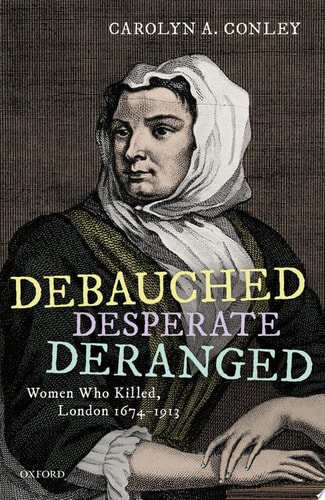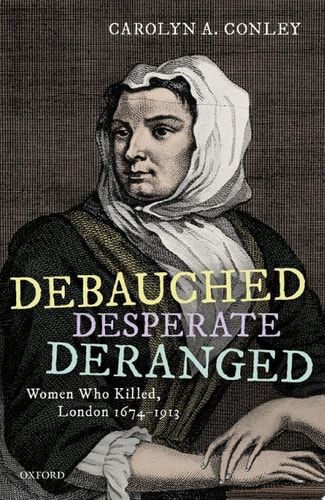
Debauched, Desperate, Deranged: Women Who Killed, London 1674-1913
0
0
As an Amazon Associate and affiliate partner, Menrva Books earns from qualifying purchases. Learn more
Author Description
Contemporary studies have concluded that women are far less likely to kill than men and that when women do kill, they do so within the family. Debauched, Desperate, Deranged: Women Who Killed, London 1674-1913 examines the evolution of this pattern in the over 1400 trials in which women were prosecuted for homicide in London from the late seventeenth century until just before the First World War. Which deaths were considered homicides and in what circumstances women were culpable illustrates profound changes in the prevailing assumptions about women. The outcomes of trials and the portrayals of these women in the press illuminate changes in perceptions of women's status and their physical and mental limitations. Debauched, Desperate, Deranged breaks new ground in existing studies of gender and homicide, using a long time frame to discern which trends are brief anomalies and which represent significant change or continuity. Debauched, Desperate, Deranged is the first empirical, quantitatively as well as qualitatively based study of women and homicide from the seventeenth century to the twentieth. It presents new and significant conclusions on changing incidence of maternal homicides and the remarkable constancy of spousal homicides.
Menrva's Summary
THE THESIS
This study investigates how the legal and social treatment of women who committed homicide in London evolved between 1674 and 1913. Carolyn A. Conley, a historian specializing in crime and gender, utilizes a dataset of over 1,400 homicide trials to analyze the shifting definitions of female culpability. By examining both trial outcomes and contemporary press coverage, the author constructs a framework to evaluate how societal perceptions of women's mental and physical capacities influenced the justice system over two centuries.
THE SCOPE MAP
What You Will Find
- Analysis of over 1,400 homicide trials involving female defendants in London.
- Longitudinal data tracking the incidence of maternal versus spousal homicides.
- Examination of media portrayals and their impact on public perception of female offenders.
Scope Limits
- The study is geographically restricted to London and does not account for rural or international legal variations.
- The research concludes prior to the First World War and does not address modern homicide patterns.
THE AUTHORITY PERSPECTIVE
Scholars recognize this work as a significant empirical contribution to the history of gender and criminal justice. Readers frequently note the academic density of the prose and the rigorous quantitative methodology employed by the author.
Page Count:
239
Publication Date:
2020-01-01
Publisher:
OUP Oxford
ISBN-10:
019260807X
ISBN-13:
9780192608079
History
True Crime
Sociology
London History
Legal History
Gender Studies