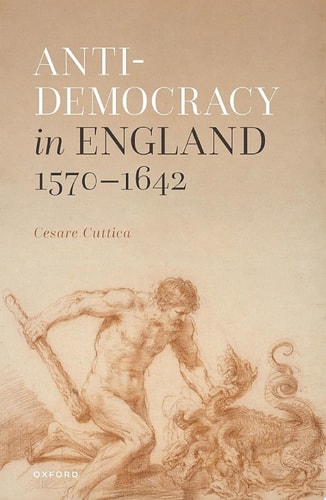
Anti-democracy in England 1570-1642
0
0
As an Amazon Associate and affiliate partner, Menrva Books earns from qualifying purchases. Learn more
Author Description
Anti-democracy in England 1570-1642 is a detailed study of anti-democratic ideas in early modern England. By examining the rich variety of debates about democracy that took place between 1570 and 1642, it shows the key importance anti-democratic language held in the late Tudor and early Stuart periods. In particular, it argues that anti-democratic critiques were addressed at 'popular government' as a regime that empowered directly and fully the irrational, uneducated, dangerous commonalty; it explains why and how criticism of democracy was articulated in the contexts here under scrutiny; and it demonstrates that the early modern era is far more relevant to the development of democratic concepts and practices than has hitherto been acknowledged. The study of anti-democracy is carried out through a close textual analysis of sources often neglected in the history of political thought and by way of a contextual approach to Elizabethan, Jacobean, and Caroline history. Most importantly, the study re-evaluates the role of religion and cultural factors in the history of democracy and of political ideas more generally. The point of departure is at a time when the establishment and Presbyterians were at loggerheads on pivotal politico-ecclesiastical and theoretical matters; the end coincides with the eruption of the Civil Wars. Cesare Cuttica not only places the unexplored issue of anti-democracy at the centre of historiographical work on early modern England, but also offers a novel analysis of a precious portion of Western political reflection and an ideal platform to discuss the legacy of principles that are still fundamental today.
Menrva's Summary
THE THESIS
This study investigates the prevalence and function of anti-democratic discourse in England between 1570 and 1642 to determine how these critiques shaped early modern political thought. Cesare Cuttica, a scholar of early modern political history, utilizes a contextual approach to examine neglected primary sources from the Elizabethan, Jacobean, and Caroline eras. He argues that anti-democratic rhetoric was not merely reactionary but a central component of political debate, specifically targeting the perceived dangers of 'popular government' and the commonalty. By integrating religious and cultural factors, the work posits that these early critiques are foundational to understanding the trajectory of Western democratic development.
THE SCOPE MAP
What You Will Find
- Analysis of political debates regarding 'popular government' from 1570 to 1642.
- Examination of the intersection between religious conflict and political theory.
- Close textual analysis of underutilized primary sources from the late Tudor and early Stuart periods.
Scope Limits
- The study concludes at the eruption of the Civil Wars and does not extend into the later seventeenth-century political developments.
- The focus remains primarily on English political thought rather than comparative European political systems.
THE AUTHORITY PERSPECTIVE
Scholars recognize this work as a significant contribution to the historiography of early modern political ideas, particularly for its focus on the intellectual origins of anti-democratic sentiment. Readers frequently note the academic density of the prose and the rigorous contextualization of historical texts within their specific religious and cultural environments.
Page Count:
294
Publication Date:
2022-01-01
Publisher:
OUP Oxford
ISBN-10:
0192690930
ISBN-13:
9780192690937
History
Tudor History
History of the Americas
Political Philosophy
Early Modern
Stuart History
Community Tags
Similar Books