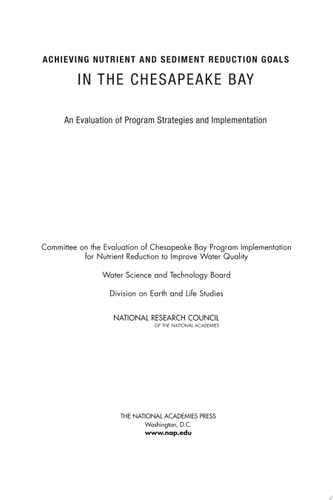
Achieving Nutrient and Sediment Reduction Goals in the Chesapeake Bay: An Evaluation of Program Strategies and Implementation
0
0
As an Amazon Associate and affiliate partner, Menrva Books earns from qualifying purchases. Learn more
Author Description
The Chesapeake Bay is North America's largest and most biologically diverse estuary, as well as an important commercial and recreational resource. However, excessive amounts of nitrogen, phosphorus, and sediment from human activities and land development have disrupted the ecosystem, causing harmful algae blooms, degraded habitats, and diminished populations of many species of fish and shellfish. In 1983, the Chesapeake Bay Program (CBP) was established, based on a cooperative partnership among the U.S. Environmental Protection Agency (EPA), the state of Maryland, and the commonwealths of Pennsylvania and Virginia, and the District of Columbia, to address the extent, complexity, and sources of pollutants entering the Bay. In 2008, the CBP launched a series of initiatives to increase the transparency of the program and heighten its accountability and in 2009 an executive order injected new energy into the restoration. In addition, as part of the effect to improve the pace of progress and increase accountability in the Bay restoration, a two-year milestone strategy was introduced aimed at reducing overall pollution in the Bay by focusing on incremental, short-term commitments from each of the Bay jurisdictions. The National Research Council (NRC) established the Committee on the Evaluation of Chesapeake Bay Program Implementation for Nutrient Reduction in Improve Water Quality in 2009 in response to a request from the EPA. The committee was charged to assess the framework used by the states and the CBP for tracking nutrient and sediment control practices that are implemented in the Chesapeake Bay watershed and to evaluate the two-year milestone strategy. The committee was also to assess existing adaptive management strategies and to recommend improvements that could help CBP to meet its nutrient and sediment reduction goals. The committee did not attempt to identify every possible strategy that could be implemented but instead focused on approaches th
Menrva's Summary
THE THESIS
The Chesapeake Bay Program faces significant challenges in meeting its nutrient and sediment reduction goals due to the complex ecosystem and diverse sources of pollution. The National Research Council was tasked by the EPA to evaluate the strategies and implementation framework used by the Chesapeake Bay Program (CBP) and its partner jurisdictions. This evaluation focuses on tracking nutrient and sediment control practices, assessing the effectiveness of the two-year milestone strategy, and recommending improvements for adaptive management to achieve water quality targets.
THE SCOPE MAP
- An evaluation of the framework for tracking nutrient and sediment control practices within the Chesapeake Bay watershed.
- An assessment of the two-year milestone strategy implemented by the Chesapeake Bay Program.
- Analysis of existing adaptive management strategies employed by the CBP.
- Recommendations for improving the CBP's approach to meeting nutrient and sediment reduction goals.
- Focus on strategies and implementation rather than identifying every possible solution.
THE AUTHORITY PERSPECTIVE
This report is a technical evaluation by the National Research Council, commissioned by the EPA, to assess the effectiveness of the Chesapeake Bay Program's strategies for nutrient and sediment reduction. The authority perspective suggests a detailed, evidence-based analysis aimed at informing policy and management decisions. The scope of the work indicates a focus on the practical implementation and adaptive management of environmental restoration efforts, likely appealing to environmental scientists, policymakers, and stakeholders involved in watershed management.
Page Count:
258
Publication Date:
2011-09-26
Publisher:
National Academies Press
ISBN-10:
0309210828
ISBN-13:
9780309210829
Science
Non-Fiction
Policy
Water Quality
Conservation
Community Tags
Similar Books







Reader Comments
Share Your Thoughts
No comments yet. Be the first to share your thoughts!