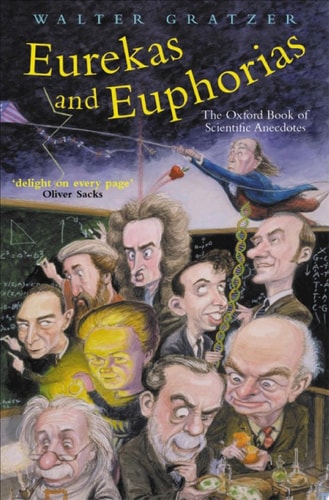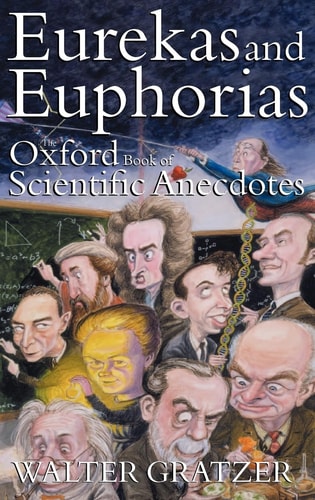
Eurekas and Euphorias: The Oxford Book of Scientific Anecdotes
0
0
As an Amazon Associate and affiliate partner, Menrva Books earns from qualifying purchases. Learn more
Author Description
The march of science has been marked through the years by episodes of drama and comedy, of failure as well as triumph, by outrageous strokes of luck, deserved and undeserved, and sometimes by human tragedy. In Eurekas and Euphorias, Walter Gratzer captures the human face of discovery as he relates many intriguing tales of scientific adventures spanning over two thousand years.Open this book at random and you may chance on the clumsy chemist named Sapper who broke a thermometer in a reaction vat and made the discovery that launched the modern dyestuff industry. Or the physicist who dissolved his gold Nobel Prize medal in acid to prevent it from falling into the hands of the Nazis. The book uncovers deep intellectual friendships, as well as ferocious animosities, and even acts of theft and malice, deceit, and a hoax or two. Indeed, we discover that scientists come in all shapes--the obsessive and the dilettantish, the genial, the envious, the preternaturally brilliant and the slow-witted who sometimes saw further in the end, the open-minded and the intolerant, recluses and arrivistes. We meet mathematicians and physicists in prison cells, and even in a madhouse, making important advances in their field. And we witness the careers, sometimes tragic, sometimes carefree, of the great women scientists, from Hypatia of Alexandria, to Sophie Germain and Sonia Kovalevskaya, to Marie Curie and her relentless battle with the French Academy.Told with wit and relish, here then is a glorious parade to delight the reader, with stories to astonish, to instruct, and most especially, to entertain.
Menrva's Summary
THE THESIS
This collection investigates the human dimension of scientific discovery, exploring how personality, luck, and social context shape the progress of human knowledge. Walter Gratzer, a distinguished scientist and writer, compiles a vast array of historical accounts to demonstrate that scientific advancement is rarely a linear process of pure logic. By examining the lives of researchers from antiquity to the modern era, the author argues that the history of science is as much a study of human character as it is of empirical data.
THE SCOPE MAP
What You Will Find
- Historical anecdotes spanning over two thousand years of scientific inquiry.
- Accounts of both famous breakthroughs and obscure, accidental discoveries.
- Profiles of diverse scientific figures, including mathematicians, physicists, and chemists.
- Narratives detailing the social, political, and personal challenges faced by researchers.
Scope Limits
- The book does not provide a comprehensive technical explanation of the scientific theories mentioned.
- It does not attempt to offer a chronological or systematic history of scientific development.
THE AUTHORITY PERSPECTIVE
Critics and readers frequently praise the book for its engaging, accessible prose and the breadth of its historical research. Experts often note that while the text is anecdotal rather than analytical, it serves as a valuable humanistic supplement to more formal histories of science.
Page Count:
320
Publication Date:
2002-11-28
Publisher:
Oxford University Press
ISBN-10:
0192804030
ISBN-13:
9780192804037
Non-Fiction
Biography
Science
Science History
Science
Anecdotes