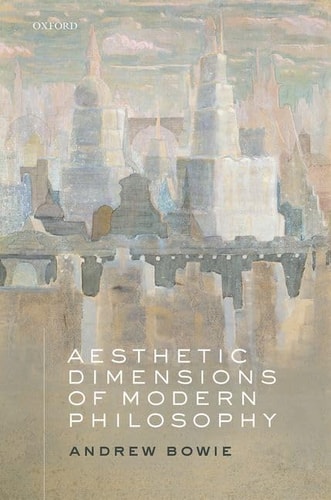
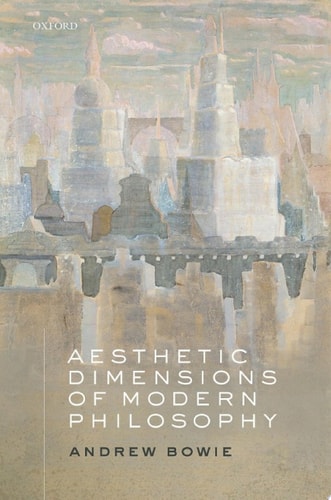
Aesthetic Dimensions of Modern Philosophy
0
0
As an Amazon Associate and affiliate partner, Menrva Books earns from qualifying purchases. Learn more
Author Description
Much of contemporary philosophy, especially in the analytical tradition, regards aesthetics as of lesser significance than epistemology, ethics, metaphysics, and the philosophy of language. Yet, in Aesthetic Dimensions of Modern Philosophy, Andrew Bowie explores the idea that art and aesthetics have crucial implications for those areas of philosophy.In the modern period, the growth of warranted scientific knowledge is accompanied both by heightened concern with epistemological scepticism and a new philosophical attention to art and the beauty of nature. This suggests that modernity involves problems concerning how human beings make sense of the world that go beyond questions of knowledge, and are reflected in the arts. The relationship of art to philosophy is explored in Montaigne, Descartes, Hume, Kant, Schelling, the early German Romantics, and Hegel. This book also considers Cassirer's and the hermeneutic tradition's exploration of close links between meaning in language and in art. The work of Karl Polanyi, Marx, Nietzsche, Heidegger, Adorno, Dewey, and others is used to investigate how the modern sciences and the development of capitalism change both humankind's relations to nature and the nature of value, and so affect the role of art in human self-understanding. The aesthetic dimensions of modern philosophy can help to uncover often neglected historical shifts in how 'subjective' and 'objective' are conceived. Seeing art as a kind of philosophy, and philosophy as a kind of art, reveals unresolved tensions between the different cultural domains of the modern world and questions some of the orientation of contemporary philosophy.
Menrva's Summary
THE THESIS
This book investigates whether art and aesthetics hold fundamental implications for core philosophical domains such as epistemology, ethics, and metaphysics. Andrew Bowie, a scholar of German philosophy, argues that the modern preoccupation with scientific knowledge often overlooks how aesthetic experience addresses the limitations of human understanding. By examining the historical trajectory from the Enlightenment to the present, the author posits that art functions as a necessary component in reconciling the subjective and objective tensions inherent in modern life.
THE SCOPE MAP
What You Will Find
- A historical survey of aesthetic thought in the works of Montaigne, Descartes, Hume, Kant, Schelling, and Hegel.
- An analysis of the hermeneutic tradition and the intersection of linguistic meaning and artistic expression.
- A critique of how capitalism and scientific advancement have altered human relations to nature and value.
Scope Limits
- The text does not provide a comprehensive history of art itself, focusing instead on the philosophical reception of art.
- It does not offer a practical guide for art criticism or aesthetic evaluation.
THE AUTHORITY PERSPECTIVE
Scholars frequently identify this work as a significant contribution to the bridge between analytical and continental philosophical traditions. Readers often note the academic density of the prose, which requires a foundational understanding of modern European philosophy to fully grasp the author's arguments.
Page Count:
240
Publication Date:
2022-10-31
Publisher:
Oxford University Press
ISBN-10:
0192847732
ISBN-13:
9780192847737
Philosophy
Politics
Philosophy history
Art Theory
History & Schools of Thought
Continental Philosophy
Aesthetics
Modern Philosophy
Community Tags
Other Editions(4)

Similar Books






Reader Comments
Share Your Thoughts
No comments yet. Be the first to share your thoughts!