
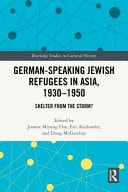
German-Speaking Jewish Refugees in Asia, 1930-1950 Shelter from the Storm?
0
0
As an Amazon Associate and affiliate partner, Menrva Books earns from qualifying purchases. Learn more
Author Description
Although most perished, hundreds of thousands of Central European Jews escaped the Holocaust; tens of thousands of these Jewish refugees ended up in East Asia, Southeast Asia, or South Asia. Taking a global and transnational approach, this volume examines the cultural, political, and socioeconomic encounters among and between Asian and European states and empires, Central European Jews, and Asians between 1930 and 1950, offering important case studies that address the policies toward and experiences of German-speaking Jews across East Asia, Southeast Asia, and South Asia. The strength of this volume lies not only in its efforts to include multiple theoretical perspectives, which integrate German, Jewish, Asian, and Migration Studies, but in the original empirical research on which it is based. Engaging directly with the rich and growing historiography on the origins, course, and consequences of the Holocaust globally and in East, Southeast, and South Asia specifically, this volume provides a framework in which we can better understand how global traditions of empire and colonialism matter in our efforts to understand the Holocaust, while indicating that Asian states and peoples were keenly aware of the so-called "Jewish Question" and made efforts, though widely differentiated, to provide shelter from the Nazi storm. German-speaking Jewish Refugees in Asia, 1930-1950 will appeal to students and scholars alike interested in the history of Jewish refugees in the twentieth century, as well as all those interested in the modern history of Germany and Asia.
Menrva's Summary
THE THESIS
This volume investigates the complex experiences of German-speaking Jewish refugees who sought shelter in Asia between 1930 and 1950, amidst the global turmoil of the Holocaust. It examines the cultural, political, and socioeconomic interactions between Asian states, European empires, and these refugees, presenting case studies from East, Southeast, and South Asia. The work integrates theoretical perspectives from German, Jewish, Asian, and Migration Studies, grounded in original empirical research. It explores how global traditions of empire and colonialism shaped the understanding and response to the Holocaust, highlighting the awareness of the "Jewish Question" in Asia and the varied efforts to provide refuge.
THE SCOPE MAP
- Case studies on the policies toward and experiences of German-speaking Jews across East Asia, Southeast Asia, and South Asia.
- Analysis of cultural, political, and socioeconomic encounters among and between Asian and European states, empires, and Central European Jews.
- Integration of theoretical perspectives from German Studies, Jewish Studies, Asian Studies, and Migration Studies.
- Original empirical research on the refugee experience in Asia during the Holocaust era.
- Exploration of the global and colonial contexts of the Holocaust.
- Examination of Asian states' and peoples' awareness of the "Jewish Question" and their responses to refugees.
THE AUTHORITY PERSPECTIVE
This volume is positioned as a significant contribution to the historiography of the Holocaust and Jewish refugees, appealing to both students and scholars. Its strength is noted in its global and transnational approach, integrating multiple theoretical perspectives and original empirical research. The work engages with growing scholarship on the global dimensions of the Holocaust, particularly in East, Southeast, and South Asia. It aims to provide a framework for understanding the role of empire and colonialism in the Holocaust, while also detailing the specific efforts made by Asian entities to offer shelter.
Page Count:
338
Publication Date:
2025-01-01
Publisher:
Taylor & Francis Group
ISBN-10:
1032849851
ISBN-13:
9781032849850
Non-Fiction
History
Jewish History
Asian History
Migration Studies
Community Tags
Other Editions(2)
Similar Books










Reader Comments
Share Your Thoughts
No comments yet. Be the first to share your thoughts!