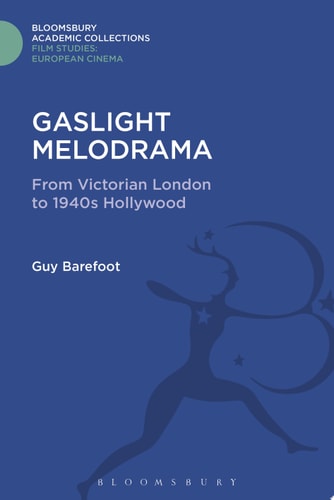
Gaslight Melodrama
0
0
As an Amazon Associate and affiliate partner, Menrva Books earns from qualifying purchases. Learn more
Author Description
In 1945, a year when American crime films were apparently moving out on to the streets of contemporary Los Angeles and New York, one reviewer noted the emergence of a 'cycle of mystery and horror pictures placed in the gaslight era of the turn of the century.' For another critic, it seemed that for Hollywood there was 'no world of today save the world of London by gaslight'. In Gaslight Melodrama, Guy Barefoot examines the films that gave rise to such comments, and the pattern of discourse that gave rise to such films. The book's main focus is provided by 1940s Hollywood melodramas such as Gaslight, Dr. Jekyll and Mr. Hyde and Hangover Square. It also discusses a related cycle of British films that located murder and melodrama in Victorian or Edwardian settings, and then looks beyond cinema to the Gothic novels of the 18th century, 19th century discussions of gas lighting in street, home and theatre, and ambivalent 20th century responses to the Victorian era. Combining close analysis of particular film texts with attention to cinema's cultural context, Gaslight Melodrama provides an exploration of the ways in which the past has been the site of contested meaning, and an examination of the network of melodramatic narratives embedded within familiar and lesser-known examples of classical Hollywood cinema.
Menrva's Summary
THE THESIS
The book investigates the recurring use of gaslight-era settings in 1940s Hollywood and British cinema, and the cultural discourses that fueled this trend. Guy Barefoot examines a cycle of mystery and horror films from the 1940s that were set in the late 19th and early 20th centuries, focusing on melodramas such as 'Gaslight,' 'Dr. Jekyll and Mr. Hyde,' and 'Hangover Square.' The analysis extends beyond film to include the Gothic novels of the 18th century, historical discussions of gas lighting, and evolving 20th-century perceptions of the Victorian era. By combining close readings of film texts with an exploration of their cultural contexts, the book reveals how the past served as a site for contested meanings within classical Hollywood cinema.
THE SCOPE MAP
- Analysis of 1940s Hollywood melodramas set in the gaslight era.
- Examination of British films with Victorian or Edwardian settings.
- Exploration of 18th and 19th-century Gothic novels.
- Discussion of historical discourse surrounding gas lighting.
- Investigation of 20th-century responses to the Victorian era.
- Close analysis of specific film texts.
- Consideration of cinema's broader cultural context.
- Exploration of how the past becomes a site of contested meaning.
THE AUTHORITY PERSPECTIVE
The book is recognized for its scholarly approach to film history and cultural studies, offering a detailed examination of a specific cinematic trend. It is noted for its ability to connect film analysis with broader historical and literary contexts, providing a nuanced understanding of how the past was represented and reinterpreted. The work is likely to appeal to academics and enthusiasts of classic cinema, Gothic literature, and Victorian studies. Its comprehensive scope, bridging film, literature, and social history, positions it as a valuable contribution to understanding the interplay between historical periods and cinematic imagination.
Page Count:
240
Publication Date:
2016-10-06
Publisher:
Bloomsbury UK
ISBN-10:
1474290361
ISBN-13:
9781474290364
Drama
History
Art
Non-Fiction
Literary Criticism
Film Studies
Gothic
Cultural History
Victorian Era
Community Tags
Similar Books