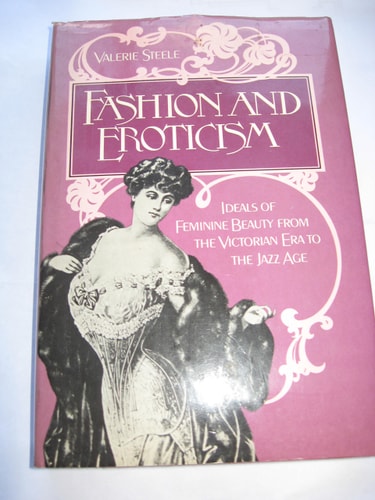
Fashion and Eroticism: Ideals of Feminine Beauty from the Victorian Era Through the Jazz Age
0
0
As an Amazon Associate and affiliate partner, Menrva Books earns from qualifying purchases. Learn more
Author Description
The traditional image of the Victorian woman presents her as strait-laced and prudish, her clothing an outward sign of her sexual repression and exploitation. This situation supposedly persisted until the Women's Rights Movement and World War I forced the world to acknowledge that women were liberated individuals with legs. Yet Valerie Steele demonstrates that eroticism formed the basis for the Victorian ideal of feminine beauty and fashion--indeed, that the concepts of beauty and fashion are essentially erotic. She shows that, far from being passive "sex objects," Victorian women, like their modern counterparts, themselves chose to emulate an erotic ideal as an aspect of their own self-fulfillment. Even the notorious corset was neither fetishistic nor an unhealthy instrument of torture, she argues, although its complex and ambivalent sexual symbolism aroused controversy. Fashion and Eroticism shows how the New Look of "sexy" modern naturally from within the pre-war world of fashion and not as part of an anti-fashion movement. Steele's conclusions are based on prodigious documentary evidence, including visual and material research, in costume collections in the United States, Great Britain, Europe, and even Japan. Fashion and Eroticism is not only a radical revision of the conventional understanding of Victorian fashion; it is a major contribution to the history of women and sexuality.
Menrva's Summary
THE THESIS
This work investigates the intersection of fashion and eroticism to challenge the conventional narrative that Victorian women were sexually repressed by their clothing. Valerie Steele, a historian with a Ph.D. from Yale and extensive experience in costume curation, utilizes a vast array of primary source material to argue that feminine beauty ideals were fundamentally rooted in eroticism. She posits that Victorian women actively participated in shaping these ideals as a form of self-expression rather than merely acting as passive victims of restrictive garments.
THE SCOPE MAP
What You Will Find
- Analysis of the evolution of feminine beauty ideals from the Victorian era through the Jazz Age.
- Re-evaluation of the cultural and sexual symbolism of the corset.
- Extensive documentary evidence sourced from international costume collections in the United States, Great Britain, Europe, and Japan.
- Examination of the transition from pre-war fashion norms to the emergence of the modern 'sexy' aesthetic.
THE AUTHORITY PERSPECTIVE
Scholars and historians recognize this text as a significant revisionist study that complicates the traditional understanding of nineteenth-century gender roles. Experts frequently cite Steele's research for its meticulous use of material culture and its ability to bridge the gap between fashion history and the history of sexuality.
Page Count:
327
Publication Date:
1985-05-09
Publisher:
Oxford University Press
ISBN-10:
0195035305
ISBN-13:
9780195035308
History
Cultural History
Sociology
Fashion
Community Tags
Similar Books