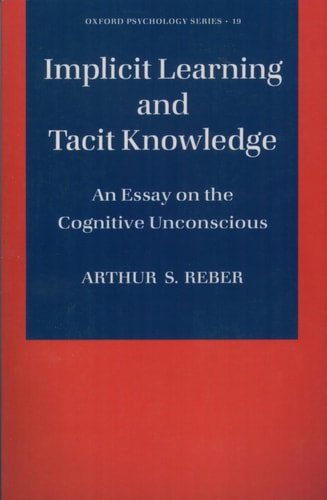
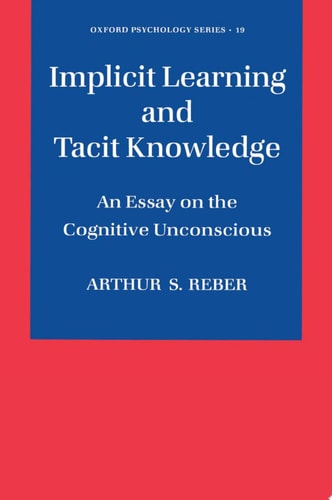
Implicit Learning and Tacit Knowledge: An Essay on the Cognitive Unconscious
0
0
As an Amazon Associate and affiliate partner, Menrva Books earns from qualifying purchases. Learn more
Author Description
In this new volume in the Oxford Psychology Series, the author presents a highly readable account of the cognitive unconscious, focusing in particular on the problem of implicit learning. Implicit learning is defined as the acquisition of knowledge that takes place independently of the conscious attempts to learn and largely in the absence of explicit knowledge about what was acquired. One of the core assumptions of this argument is that implicit learning is a fundamental, "root" process, one that lies at the very heart of the adaptive behavioral repertoire of every complex organism. The author's goals are to outline the essential features of implicit learning that have emerged from the many studies that have been carried out in a variety of experimental laboratories over the past several decades; to present the various alternative perspectives on this issue that have been proposed by other researchers and to try to accommodate these views with his own; to structure the literature so that it can be seen in the context of standard heuristics of evolutionary biology; to present the material within a functionalist approach and to try to show why the experimental data should be seen as entailing particular epistemological perspectives; and to present implicit processing as encompassing a general and ubiquitous set of operations that have wide currency and several possible applications. Chapter 1 begins with the core problem under consideration in this book, a characterization of "implicit learning" as it has come to be used in the literature. Reber puts this seemingly specialized topic into a general framework and suggests a theoretical model based on standard heuristics of evolutionary biology. In his account, Reber weaves a capsule history of interest in and work on the cognitive unconscious. Chapter 2 turns to a detailed overview of the experimental work on the acquisition of implicit knowledge, which currently is of great interest. Chapter 3 develops the evolutionar
Menrva's Summary
THE THESIS
This book investigates the fundamental nature of the cognitive unconscious by examining implicit learning as a primary, evolutionary root process. Arthur S. Reber, a prominent researcher in the field, utilizes decades of experimental laboratory data to argue that the acquisition of knowledge often occurs independently of conscious effort. By applying a functionalist approach and evolutionary heuristics, the author constructs a theoretical framework that positions implicit processing as a ubiquitous and essential component of the adaptive behavioral repertoire in complex organisms.
THE SCOPE MAP
What You Will Find
- A comprehensive synthesis of experimental studies regarding implicit knowledge acquisition.
- A theoretical model linking cognitive unconscious processes to evolutionary biology heuristics.
- A comparative analysis of alternative perspectives within the field of cognitive psychology.
- A functionalist examination of how implicit processing serves as a foundational mechanism for human behavior.
THE AUTHORITY PERSPECTIVE
Experts recognize this work as a foundational text that successfully bridges the gap between experimental psychology and evolutionary theory. Readers frequently note the academic density of the prose, which provides a rigorous and systematic overview of the cognitive unconscious for students and researchers alike.
Page Count:
200
Publication Date:
1996-09-05
Publisher:
Oxford University Press
ISBN-10:
019510658X
ISBN-13:
9780195106589
Psychology
Non-Fiction
Evolutionary Biology
Neuroscience
Knowledge Theory
Community Tags
Other Editions(4)

Similar Books



Reader Comments
Share Your Thoughts
No comments yet. Be the first to share your thoughts!