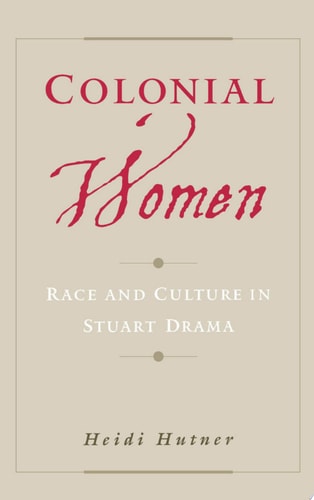
Colonial Women: Race and Culture in Stuart Drama
0
0
As an Amazon Associate and affiliate partner, Menrva Books earns from qualifying purchases. Learn more
Author Description
Colonial Women examines the women-as-land metaphor in English colonial dramatic literature of the seventeenth century, and looks closely at the myths of two historical native female figures--Pocahontas of Virginia and Malinche of Mexico--to demonstrate how these two stories are crucial to constructions of gender, race, and English nationhood in the drama and culture of the period.Heidi Hutner's interpretations of the figure of the native woman in the plays of Shakespeare, Fletcher, Davenant, Dryden, and Behn reveal how the English patriarchal culture of the seventeenth century defined itself through representations of native women and European women who have "gone native." These playwrights use the figure of the native woman as a symbolic means to stabilize the turbulent sociopolitical and religious conflicts in Restoration England under the inclusive ideology of expansion and profit. Colonial Women uncovers the significance of the repeated dramatic spectacle of the native women falling for her European seducer and exploiter, and demonstrates that this image of seduction is motivated by an anxiety-laden movement to reinforce patriarchal authority in seventeenth-century England.
Menrva's Summary
THE THESIS
This work investigates how seventeenth-century English dramatic literature utilized the metaphor of women-as-land to construct and reinforce ideologies of gender, race, and national identity. Heidi Hutner, an academic specializing in early modern literature, utilizes a framework of cultural materialism and feminist theory to analyze plays by authors such as Shakespeare, Fletcher, and Behn. By examining the recurring mythologies of Pocahontas and Malinche, the text argues that these representations served to stabilize sociopolitical anxieties in Restoration England by justifying colonial expansion and patriarchal authority.
THE SCOPE MAP
What You Will Find
- Analysis of seventeenth-century English colonial dramatic literature.
- Examination of the symbolic function of native female figures in European plays.
- Case studies of historical figures including Pocahontas and Malinche.
- Exploration of the intersection between gender, race, and English nationhood.
THE AUTHORITY PERSPECTIVE
Scholars in the field of early modern studies frequently cite this text for its rigorous application of postcolonial theory to Restoration drama. The prose is noted for its academic density and its contribution to understanding the symbolic role of women in colonial discourse.
Page Count:
152
Publication Date:
2001-10-04
Publisher:
Oxford University Press
ISBN-10:
0195141881
ISBN-13:
9780195141887
Drama
History
English
Women and literature
Seventeenth Century
Literary Criticism
Gender Studies
English & College Success
In literature
English drama
Community Tags
Similar Books