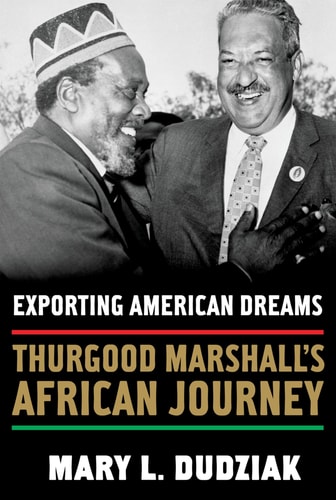
Exporting American Dreams: Thurgood Marshall's African Journey
0
0
As an Amazon Associate and affiliate partner, Menrva Books earns from qualifying purchases. Learn more
Author Description
Thurgood Marshall became a living icon of civil rights when he argued Brown v. Board of Education before the Supreme Court in 1954. Six years later, he was at a crossroads. A rising generation of activists were making sit-ins and demonstrations rather than lawsuits the hallmark of the civil rights movement. What role, he wondered, could he now play? When in 1960 Kenyan independence leaders asked him to help write their constitution, Marshall threw himself into their cause. Here was a new arena in which law might serve as the tool with which to forge a just society.In Exporting American Dreams, Mary Dudziak recounts with poignancy and power the untold story of Marshall's journey to Africa. African Americans were enslaved when the U.S. constitution was written. In Kenya, Marshall could become something that had not existed in his own country: a black man helping to found a nation. He became friends with Kenyan leaders Tom Mboya and Jomo Kenyatta, serving as advisor to the Kenyans, who needed to demonstrate to Great Britain and to the world that they would treat minority races (whites and Asians) fairly once Africans took power. He crafted a bill of rights, aiding constitutional negotiations that helped enable peaceful regime change, rather than violent resistance.Marshall's involvement with Kenya's foundation affirmed his faith in law, while also forcing him to understand how the struggle for justice could be compromised by the imperatives of sovereignty. Marshall's beliefs were most sorely tested later in the decade when he became a Supreme Court Justice, even as American cities erupted in flames and civil rights progress stalled. Kenya's first attempt at democracy faltered, but Marshall's African journey remained a cherished memory of a time and a place when all things seemed possible.
Menrva's Summary
THE THESIS
How did Thurgood Marshall’s participation in the drafting of the Kenyan constitution influence his understanding of law as a mechanism for social justice? Mary L. Dudziak, a legal historian, utilizes archival research and personal correspondence to examine this pivotal moment in Marshall's career. She argues that this international experience provided Marshall with a unique perspective on constitutionalism, sovereignty, and the limitations of legal reform during a period of intense domestic civil rights struggle in the United States.
THE SCOPE MAP
What You Will Find
- Historical analysis of the 1960 Kenyan constitutional negotiations.
- Examination of the relationship between Thurgood Marshall, Tom Mboya, and Jomo Kenyatta.
- Primary source evidence including legal drafts and personal correspondence.
- Exploration of the intersection between American civil rights activism and global decolonization movements.
THE AUTHORITY PERSPECTIVE
Historians and legal scholars frequently cite this work for its nuanced portrayal of Marshall’s intellectual development outside of the American courtroom. Experts highlight the text as a significant contribution to understanding the global reach of American legal philosophy during the mid-twentieth century.
Page Count:
271
Publication Date:
2008-01-01
Publisher:
Oxford University Press
ISBN-10:
0195329015
ISBN-13:
9780195329018
History
Biography
Civil Rights
Legal Profession
Judges biography
African history
Legal History
Africa East
Africa - History
Politics & Government
Community Tags
Other Editions(2)
Similar Books
Reader Comments
Share Your Thoughts
No comments yet. Be the first to share your thoughts!