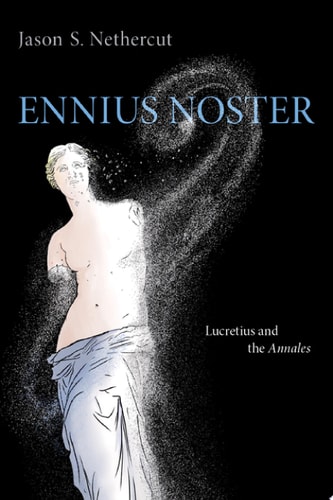
Ennius Noster: Lucretius and the Annales
0
0
As an Amazon Associate and affiliate partner, Menrva Books earns from qualifying purchases. Learn more
Author Description
Consensus holds that Lucretius admired the literary prestige of Homeric epos, the form that Ennius famously introduced to Latin literature. However, some hold that Lucretius disagreed with Ennius' quasi-Pythagorean claim to be Homer reborn, and so uniquely qualified to adapt Homeric poetry to the Latin language. Likewise, received wisdom holds that Lucretius followed in the path of poets writing in the wake of Ennius' Annales, most of whom employed an Ennian style. However, throughout the De Rerum Natura, Lucretius' use of Ennius' Annales as a formal model for a long discursive poem in epic meter was neither inevitable nor predictable, on the one hand, nor meaningful in the simple way that critical consensus has always maintained. Jason Nethercut posits that Lucretius selected Ennius as a model precisely to dismantle the values for which he claimed Ennius stood, including the importance of history as a poetic subject and Rome's historical achievement in particular. As the first book to offer substantial analysis of the relationship between two of the ancient world's most impactful poets, Ennius Noster: Lucretius and the Annales fills an important gap not only in Lucretian scholarship, but also in our understanding of Latin literary history.
Menrva's Summary
THE THESIS
Does Lucretius utilize the Annales of Ennius as a mere stylistic template, or does he engage in a deliberate subversion of the values inherent in Ennian epic poetry? Jason S. Nethercut, a scholar of Latin literature, examines the complex intertextual relationship between Lucretius and Ennius. By analyzing the De Rerum Natura, Nethercut argues that Lucretius adopts the formal structure of the Annales specifically to dismantle the historical and nationalistic values that Ennius championed, thereby redefining the purpose of epic poetry in the Roman context.
THE SCOPE MAP
What You Will Find
- Comparative analysis of Lucretius' De Rerum Natura and Ennius' Annales
- Examination of the quasi-Pythagorean claims of poetic reincarnation in Roman literature
- Investigation into the role of history as a subject in Latin epic poetry
- Critical evaluation of the formal and thematic divergence between Lucretian philosophy and Ennian tradition
THE AUTHORITY PERSPECTIVE
Scholars identify this work as a significant contribution to the study of Latin literary history, particularly regarding the evolution of the epic form. The text is noted for its rigorous academic approach and its ability to challenge long-standing assumptions about the influence of Ennius on later Roman poets.
Page Count:
272
Publication Date:
2020-01-01
Publisher:
Oxford University Press
ISBN-10:
0197517714
ISBN-13:
9780197517710
Poetry
History
Philosophy
English
History & Surveys
Writing
English & College Success
Literary Criticism
Community Tags
Similar Books