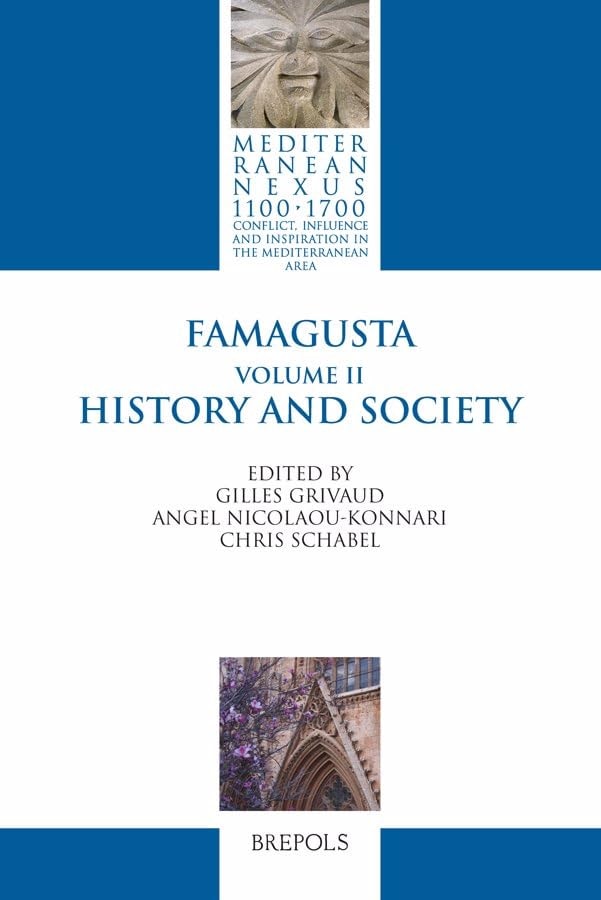
Famagusta Vol. II: History and Society
0
0
As an Amazon Associate and affiliate partner, Menrva Books earns from qualifying purchases. Learn more
Author Description
The political, social, economic, and ecclesiastical history of the city of Famagusta in Cyprus in medieval and early modern times (late 12th to late 16th century) and its image in retrospect. This is the second of two volumes on the history and archaeology of the port city of Famagusta in Cyprus from the beginning of the island's Frankish rule in 1192 to the Ottoman conquest in 1571. The first volume, entitled Art and Architecture and edited by Annemarie Weyl Carr, was published in this series in 2014. The volume provides a comprehensive survey of the four-century history of Famagusta under Frankish, Genoese, and Venetian rule down to the Ottoman siege and conquest, supplemented by an account of the image of the medieval and Renaissance city in retrospect. Based on original research and often using unpublished sources, fourteen acknowledged specialists study Famagusta's political, social, economic, and ecclesiastical history from a multi- and interdisciplinary approach that involves aspects such as institutional continuities and discontinuities, military and space organisation, religious and cultural exchanges, gender roles, and the city's image in travelogues', writers' and artists' works. Such an approach allows a better understanding of the evolution of the ethnically and religiously diverse Famagustian society from a rich commercial centre under the Lusignans to an enclave under the Genoese and a military outpost under the Venetians.
Menrva's Summary
THE THESIS
This volume investigates the multifaceted history of Famagusta, Cyprus, from the late 12th to the late 16th century, focusing on its political, social, economic, and ecclesiastical development under Frankish, Genoese, and Venetian rule. It builds upon previous archaeological and artistic studies to present a comprehensive survey of the city's evolution. Fourteen specialists contribute original research, often utilizing unpublished sources, to explore institutional changes, military organization, religious and cultural exchanges, gender roles, and the city's representation in various media. This interdisciplinary approach aims to illuminate the transformation of Famagusta from a prosperous commercial hub to a strategic military outpost.
THE SCOPE MAP
- A detailed examination of Famagusta's political structures and governance under successive European rulers.
- Analysis of the city's economic activities, trade networks, and commercial significance.
- Exploration of ecclesiastical institutions, religious practices, and cultural exchanges within the diverse population.
- Discussion of military organization, urban planning, and spatial development.
- Insights into gender roles and social dynamics within Famagustian society.
- An account of Famagusta's image and representation in historical travelogues, literature, and art.
- Coverage of the period from the beginning of Frankish rule (1192) to the Ottoman conquest (1571).
THE AUTHORITY PERSPECTIVE
This scholarly work is presented as the second volume in a series dedicated to Famagusta, following a 2014 publication on its art and architecture. The contributors are acknowledged specialists who draw on original research and unpublished sources, indicating a rigorous academic approach. The multi- and interdisciplinary methodology suggests a comprehensive and nuanced exploration of the city's history, appealing to specialists in medieval and early modern Mediterranean studies. The volume aims to provide a deeper understanding of the evolution of a complex, ethnically and religiously diverse urban society.
Page Count:
912
Publication Date:
2021-02-18
Publisher:
Brepols
ISBN-10:
2503590411
ISBN-13:
9782503590417
Non-Fiction
History
Religious History
Economic History
Social History
Urban History
Cultural History
Community Tags
Similar Books