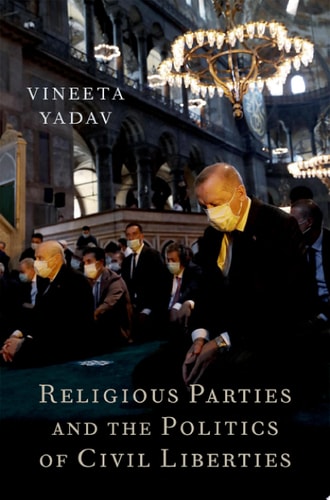
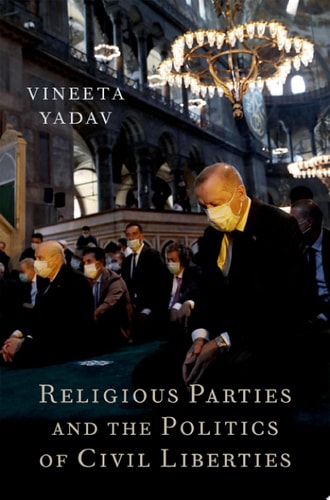
Religious Parties and the Politics of Civil Liberties
0
0
As an Amazon Associate and affiliate partner, Menrva Books earns from qualifying purchases. Learn more
Author Description
A data-driven explanation of when successful religious parties reduce the civil liberties of their citizens in Muslim-majority countries and when they don't.Religious parties are increasingly common across the world. More and more, they participate in elections, win legislative seats, and join governments, particularly in Muslim-majority countries. Since they are often founded on orthodox principles that are inconsistent with liberal democracy, their rise potentially holds consequences for the prospects of liberal democratic values and practices-and this risk has inspired much heated debate. In Religious Parties and the Politics of Civil Liberties, the award-winning political science scholar Vineeta Yadav considers a question that has been central to the discussion: Will the success of religious parties lead to declines in the civil liberties of their citizens? Yadav summarizes the popular and academic sides of the conversation and addresses the weaknesses of both by presenting an original empirical analysis of religious parties' actual relationship to civil liberties. Many believe that if religious parties come to power, they will curb civil liberties in order to realize their religious visions. Academic research on religious parties, however, claims that the need to compete in elections incentivizes religious parties to moderate their behaviors and policies, including on civil liberties. Neither of these assertions has been systematically tested until now. With this book, Yadav adjudicates the debate using systematic data that covers all Muslim-majority countries for a period of almost forty years. She highlights the role that religious lobbies play in this issue and goes on to identify the specific conditions under which religious parties do or don't curb civil liberties. A sweeping comparative account that combines large-N analysis with focused studies of Turkey and Pakistan, this book will reshape our understanding of the relationship between religious party strength and civil liberties.
Menrva's Summary
THE THESIS
Does the electoral success of religious parties in Muslim-majority countries inevitably lead to a decline in civil liberties for their citizens? Vineeta Yadav, a distinguished political science scholar, investigates this question by moving beyond theoretical speculation to provide a rigorous empirical analysis. By examining nearly forty years of data across Muslim-majority nations, she evaluates the competing claims that religious parties either inherently suppress liberties to enforce orthodoxy or are forced to moderate their platforms due to the pressures of electoral competition. Her work establishes a new framework for understanding how institutional constraints and religious lobbying influence policy outcomes.
THE SCOPE MAP
What You Will Find
- A comprehensive longitudinal data set covering Muslim-majority countries over a forty-year period.
- A comparative analysis methodology that balances large-N statistical modeling with qualitative case studies.
- In-depth examinations of political dynamics in Turkey and Pakistan as primary case studies.
- An identification of specific institutional and social conditions that dictate whether religious parties will restrict or protect civil liberties.
THE AUTHORITY PERSPECTIVE
Experts in comparative politics and Middle Eastern studies identify this work as a significant contribution to the study of religious parties and democratic governance. Readers frequently note the academic density of the prose and the systematic nature of the empirical evidence provided.
Page Count:
383
Publication Date:
2021-01-01
Publisher:
Oxford University Press
ISBN-10:
0197545386
ISBN-13:
9780197545386
Religion
Comparative Politics
Civil Rights
Democracy
Community Tags
Other Editions(3)

Similar Books



Reader Comments
Share Your Thoughts
No comments yet. Be the first to share your thoughts!