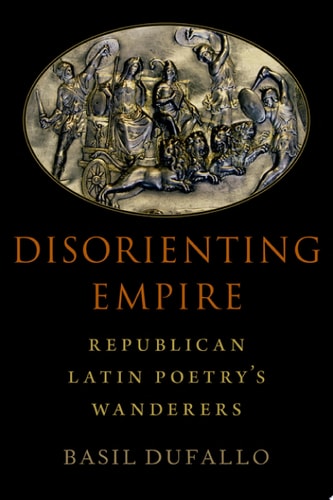
Disorienting Empire: Republican Latin Poetry's Wanderers
0
0
As an Amazon Associate and affiliate partner, Menrva Books earns from qualifying purchases. Learn more
Author Description
Disorienting Empire is the first book to examine Republican Latin poetry's recurring interest in characters who become lost. Basil Dufallo explains the prevalence of this theme with reference to the rapid expansion of Rome's empire in the Middle and Late Republic. It was both a threatening and an enticing prospect, Dufallo argues, to imagine the ever-widening spaces of Roman power as a place where one could become disoriented, both in terms of geographical wandering and in a more abstract sense connected with identity and identification, especially as it concerned gender and sexuality.Plautus, Terence, Lucretius, and Catullus, as well as the "triumviral" Horace of Satires, book 1, all reveal an interest in such experiences, particularly in relation to journeys into the Greek world from which these writers drew their source material. Fragmentary authors such as Naevius, Ennius, and Lucilius, as well as prose historians including Polybius and Livy, add depth and context to the discussion. Setting the Republican poets in dialogue with queer theory and postcolonial theory, Dufallo brings to light both anxieties latent in the theme and the exuberance it suggests over new creative possibilities opened up by reorienting oneself toward new horizons, new identifications-by discovering with pleasure that one could be other than one thought. Further, in showing that the Republican poets had been experimenting with such techniques for generations before the Augustan Age, Disorienting Empire offers its close readings as a means of interpreting afresh Aeneas' wandering journey in Vergil's Aeneid.
Menrva's Summary
THE THESIS
This book investigates how the recurring theme of the 'lost' or wandering character in Republican Latin poetry reflects the anxieties and possibilities created by Rome's rapid imperial expansion. Basil Dufallo, a scholar of classical literature, utilizes a framework that integrates queer theory and postcolonial theory to analyze the works of major and fragmentary Republican poets. He argues that the disorientation experienced by these characters serves as a metaphor for shifting identities and the destabilization of traditional Roman norms during a period of significant geopolitical change. By examining these texts, the author demonstrates that the experimentation with identity and geography predates the Augustan Age and provides a critical lens for understanding later works like the Aeneid.
THE SCOPE MAP
What You Will Find
- Analysis of Republican Latin poets including Plautus, Terence, Lucretius, Catullus, and Horace.
- Integration of queer theory and postcolonial theory to interpret themes of displacement and identity.
- Examination of fragmentary authors such as Naevius, Ennius, and Lucilius alongside prose historians like Polybius and Livy.
- A re-evaluation of the wandering motif in Vergil's Aeneid through the lens of earlier Republican poetic techniques.
THE AUTHORITY PERSPECTIVE
Scholars and students of classical literature recognize this work as a significant contribution to the study of Republican poetry, particularly for its innovative application of modern critical theory to ancient texts. Readers frequently note the academic density of the prose, which provides a rigorous and nuanced interpretation of how Roman expansion influenced the literary imagination of the era.
Page Count:
327
Publication Date:
2021-01-01
Publisher:
Oxford University Press
ISBN-10:
0197571808
ISBN-13:
9780197571804
History
Poetry
Latin poetry
Literary Criticism
English & College Success
English
In literature
Queer Theory
Community Tags
Similar Books