India's First Dictatorship
0
0
As an Amazon Associate and affiliate partner, Menrva Books earns from qualifying purchases. Learn more
Author Description
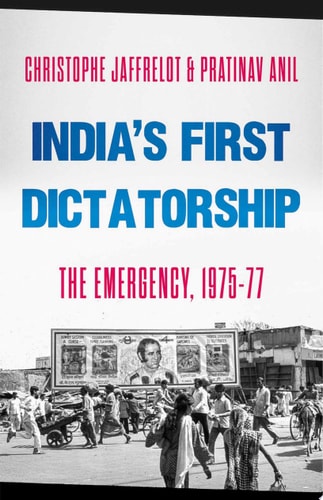
In June 1975 Prime Minister Indira Gandhi imposed a 'State of Emergency', resulting in a 21-month suspension of democracy. Jaffrelot and Anil explore this black page in India's history, a constitutional dictatorship of unequal impact, with South India largely spared thanks to the resilience of Indian federalism.India's First Dictatorship focuses on Mrs Gandhi and her son, Sanjay, who was largely responsible for the mass sterilisation programmes and deportation of urban slum-dwellers. However, it equally exposes the facilitation of authoritarian rule by Congressmen, Communists, trade unions, businessmen and the urban middle class, as well as the complacency of the judiciary and media. While opposition leaders eventually closed ranks in jail, many of them collaborated with the new regime--including the RSS. Those who resisted the Emergency, in the media or on the streets, were few in number.This episode was an acid test for India's political culture. While a tiny minority of citizens fought for democracy during the Emergency, in large numbers the people bowed to a strong woman, even worshipped her. Equally importantly, Hindu nationalists were endowed with a new legitimacy. The Emergency was not a parenthesis, but a turning point; its legacy is very much alive today.
Menrva's Summary
THE THESIS
This book investigates the 21-month period of the Indian Emergency (1975-1977) to determine how a constitutional democracy was dismantled from within and the long-term consequences of this authoritarian shift. Pratinav Anil and Christophe Jaffrelot, both scholars of South Asian politics, utilize historical archives and political analysis to argue that the Emergency was not a temporary aberration but a foundational turning point in Indian governance. They examine the roles of political elites, the judiciary, and the media in facilitating Indira Gandhi's regime, while also assessing the societal response to her consolidation of power.
THE SCOPE MAP
What You Will Find
- Detailed analysis of the 1975-1977 State of Emergency in India.
- Examination of the roles played by Indira Gandhi and her son, Sanjay Gandhi, in policy implementation.
- Investigation into the complicity of various institutions, including the judiciary, media, and political parties.
- Assessment of the long-term impact of the Emergency on modern Indian political culture and Hindu nationalism.
THE AUTHORITY PERSPECTIVE
Experts recognize this work as a rigorous historical account that challenges the narrative of the Emergency as a mere parenthesis in Indian history. Readers frequently note the depth of the research and the authors' willingness to address the institutional failures that allowed authoritarianism to take root.
Page Count:
534
Publication Date:
2021-01-01
Publisher:
Oxford University Press
ISBN-10:
0197580556
ISBN-13:
9780197580554
Biography
Politics
History
Asian History
Government - Asia
India
Community Tags
Similar Books