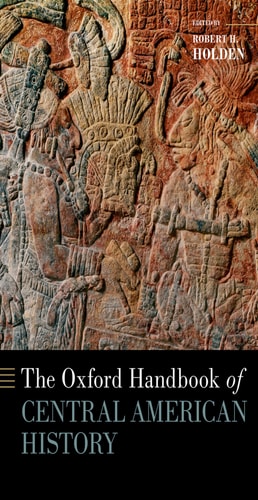
The Oxford Handbook of Central American History
0
0
As an Amazon Associate and affiliate partner, Menrva Books earns from qualifying purchases. Learn more
Author Description
Central America is a region defined primarily by its geographical configuration as a canal-friendly isthmus, and its three-century history as the Spanish Kingdom of Guatemala. Having gained independence in 1821, the Kingdom broke up into the nations of Guatemala, Honduras, El Salvador, Nicaragua, and Costa Rica after two turbulent decades as a federated republic. Political instability and violence, poverty and inequality, ethnic strife, military rule, and a historic economic dependence on the export of coffee and bananas marked the region's history. Owing to its isthmian geography and political strife, Central America became a frequent target of US government intervention. Intense US political, economic, and military action both preceded and accompanied the revolutionary civil wars of the 1970s and 1980s. With British Honduras's independence from Great Britain in 1981 as Belize, and the acquisition by Panama of full sovereignty over its territory in 1999, Central America increasingly defined itself as a region of seven countries.The Oxford Handbook of Central American History analyzes major themes in the historiography of this seven-nation region of Latin America. Individual chapters interpret the histories of each of the seven countries. Most concentrate on themes that cut across national boundaries, beginning with the history of the region's diverse natural environment, and continuing with the Indigenous peoples, the Spanish conquest and colonial rule, and the independence process. Nine chapters focus on region-wide problems that emerged with great salience after independence, including the economy, US relations, the armed forces, the Cold War, religion, and literature, among others. Together, the book's twenty-five chapters illuminate Central America's coherence as a region of Latin America while emphasizing its diversity within and across national boundaries.
Menrva's Summary
THE THESIS
This volume investigates the historical, political, and environmental factors that have shaped Central America as a distinct region within Latin America. Robert H. Holden, a scholar of Latin American history, compiles contributions from various experts to analyze the historiography of the seven nations comprising the isthmus. The text utilizes a thematic and country-specific framework to examine how colonial legacies, economic dependence, and external interventions have influenced the development of these states from the Spanish colonial period through the modern era.
THE SCOPE MAP
What You Will Find
- Comprehensive historical analysis of the seven Central American nations including Belize and Panama.
- Thematic examinations of regional issues such as the Cold War, military rule, and economic reliance on agricultural exports.
- Scholarly interpretation of the impact of United States political and military intervention in the region.
- Detailed coverage of indigenous history, colonial administration, and the transition to independent statehood.
THE AUTHORITY PERSPECTIVE
Experts recognize this handbook as a comprehensive reference for students and researchers seeking a structured overview of Central American historiography. Readers frequently note the academic density of the prose and the utility of its cross-national thematic approach in understanding regional coherence.
Page Count:
697
Publication Date:
2022-01-01
Publisher:
Oxford University Press
ISBN-10:
0197638503
ISBN-13:
9780197638507
History
International relations
History of the Americas
Reference
English
English & College Success
Community Tags
Similar Books