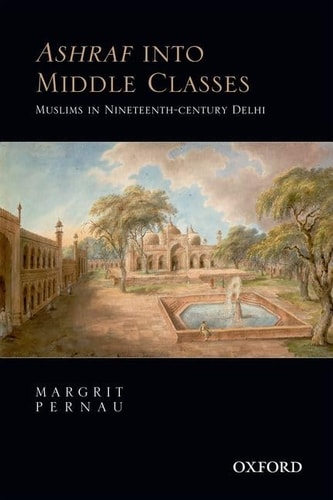
Ashraf into Middle Classes: Muslims in Nineteenth-century Delhi
0
0
As an Amazon Associate and affiliate partner, Menrva Books earns from qualifying purchases. Learn more
Author Description
Nineteenth-century Delhi was marked by a curious mixture of political upheaval and cultural resurgence. Drawing on a wide variety of little-known sources in Urdu and Persian, apart from the more conventional British records, this book provides a revelatory and vivid narrative of Muslims in the period covering the British conquest in 1803 to the end of the Khilafat movement in 1922. Moving away from the tendency of studies on Muslims to focus on religious identity, this book allows us to historicize Islam and socially contextualize its many manifestations.Treating identities as inherently dynamic and ever changing, Pernau argues that religious identity became central for Muslims only in the last third of the nineteenth century, and this was closely linked with the creation of a middle class whose members described themselves as ashraf, or "men from a good family." The new concept of respectability or sharafat on which the middle class was based allowed it to, at once, draw a distance from the old nobility, bring the learned section of the community closer to the businessmen, and demarcate it sharply from the subalterns.The book focuses on the agency of historical actors--their perceptions and memories--to help us understand what it means to be a "Muslim" as well as fathom the varied interactions between identities defined by religion, language, geography, and gender.
Menrva's Summary
THE THESIS
This book investigates how the concept of the 'ashraf' or 'men from a good family' emerged as a defining marker of middle-class identity among Muslims in nineteenth-century Delhi. Margrit Pernau, a historian specializing in South Asian social history, utilizes a diverse array of primary sources, including Urdu and Persian texts alongside British colonial records. She argues that religious identity was not a static monolith but a dynamic construct that evolved alongside the socio-economic shifts of the period. By examining the transition from the British conquest in 1803 to the early twentieth century, the author demonstrates how the pursuit of 'sharafat' or respectability facilitated the formation of a new middle class that bridged the gap between traditional nobility and the emerging merchant class.
THE SCOPE MAP
What You Will Find
- A detailed historical analysis of Delhi from 1803 to 1922.
- An examination of the social construction of 'ashraf' identity and its relationship to respectability.
- Extensive use of primary source material in Urdu and Persian language archives.
- A methodological framework that prioritizes the agency and perceptions of historical actors over rigid religious categorization.
THE AUTHORITY PERSPECTIVE
Scholars in the field of South Asian history recognize this work as a significant contribution to the study of social stratification and identity formation in colonial India. Readers frequently note the academic density of the prose and the author's meticulous approach to integrating non-Western archival sources into the historical narrative.
Page Count:
544
Publication Date:
2013-08-31
Publisher:
Oxford University Press
ISBN-10:
0198092288
ISBN-13:
9780198092285
History
Cultural History
Islam
Sociology
Social History
Mogul Empire
Muslims india
Community Tags
Similar Books