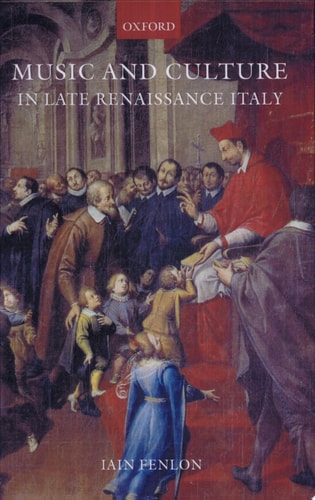
Music and Culture in Late Renaissance Italy
0
0
As an Amazon Associate and affiliate partner, Menrva Books earns from qualifying purchases. Learn more
Author Description
This collection of essays is unified by a number of concerns: one is the way in which musical activity of all kinds was instrumentalized by those in power, in Italy, during the Sixteenth Century. A second expressed through the chornological concentration on the second half of the century, is with a period which is still often regarded as one of decline and degeneracy after the achievements of the Quattrocento and the decades before the calamètà d'Italia. This book implicitly argues that Italian culture did not lose its vigor after 1530, but underwent a transformation, as both individuals and institutions reacted to new economic, political, and religious circumstances.
Menrva's Summary
THE THESIS
This collection of essays investigates how musical activity in sixteenth-century Italy functioned as a tool for political and social power during a period of significant institutional transformation. Iain Fenlon, a scholar of Renaissance music, challenges the historical narrative that Italian culture entered a state of decline after 1530. By examining the intersection of economic, political, and religious shifts, the author argues that the era was defined by adaptation and evolution rather than stagnation.
THE SCOPE MAP
What You Will Find
- Analysis of musical patronage and institutional power dynamics in sixteenth-century Italy.
- Examination of the cultural transition following the calamità d'Italia.
- Case studies focusing on the second half of the sixteenth century.
- Historical evidence linking musical production to shifting religious and economic circumstances.
THE AUTHORITY PERSPECTIVE
Experts recognize this work as a significant contribution to the study of late Renaissance musicology and cultural history. Readers frequently note the academic density of the prose and the author's ability to synthesize complex political history with musical development.
Page Count:
288
Publication Date:
2003-02-13
Publisher:
Oxford University Press
ISBN-10:
0198164440
ISBN-13:
9780198164449
Music
History
Musicology
Renaissance
Cultural History
Italy
Community Tags
Similar Books