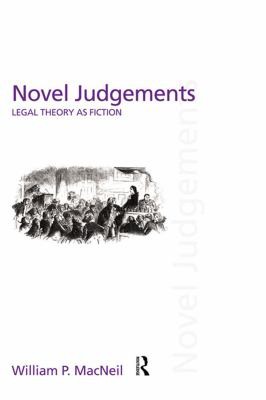
Novel Judgements
0
0
As an Amazon Associate and affiliate partner, Menrva Books earns from qualifying purchases. Learn more
Author Description
Novel Judgements is a book about nineteenth century Anglo-American law and literature. But by redefining law as legal theory, Novel judgements departs from 'socio-legal' studies of law and literature, often dated in their focus on past lawyering and court processes. This texts 'theoretical turn' renders the period's 'law-and-literature' relevant to today's readers because the nineteenth century novel, when 'read jurisprudentially', abounds in representations of law's controlling concepts, many of which are still with us today. Rights, justice, law's morality; each are encoded novelistically in stock devices such as the country house, friendship, love, courtship and marriage. In so rendering the public (law) as private (domesticity), these novels expose for legal and literary scholars alike the ways in which law comes to mediate all relationships--individual and collective, personal and political--during the nineteenth century, a period as much under the Rule of Law as the reign of Capital. So these novels pass judgement--a novel judgement--on the extent to which the nineteenth century's idea of law is collusive with that era's Capital, thereby opening up the possibility of a new legal theoretical position: that of a critique of the law and a law of critique
Menrva's Summary
THE THESIS
This book redefines the study of law and literature by focusing on legal theory within nineteenth-century Anglo-American novels. It moves beyond traditional socio-legal analyses of past legal practices to explore how the period's novels, when read jurisprudentially, engage with enduring legal concepts like rights, justice, and law's morality. By encoding these ideas within domestic and personal narratives, the novels reveal law's pervasive mediation of relationships in an era dominated by both the Rule of Law and capital. This approach allows for a critique of the nineteenth century's conception of law and its relationship with capital, paving the way for a new legal theoretical position.
THE SCOPE MAP
- Analysis of nineteenth-century Anglo-American law and literature through a legal theory lens.
- Exploration of how novels represent controlling legal concepts still relevant today.
- Examination of stock devices like the country house, friendship, love, courtship, and marriage as vehicles for legal encoding.
- Demonstration of how public law is rendered private through domesticity in novels.
- Discussion of law's mediation of individual and collective relationships in the nineteenth century.
- Critique of the relationship between law and capital in the nineteenth century as depicted in novels.
- Proposal of a new legal theoretical position: a critique of law and a law of critique.
THE AUTHORITY PERSPECTIVE
The book is positioned as a departure from traditional socio-legal studies by focusing on legal theory and its contemporary relevance. Its 'theoretical turn' aims to make nineteenth-century literature accessible to modern readers by highlighting enduring legal concepts embedded within the novels. The work is intended for both legal and literary scholars, offering a framework for understanding how law mediated relationships and interacted with capital during the Victorian era. The publisher's description suggests a scholarly approach that bridges disciplines and offers a critical perspective on historical legal thought.
Page Count:
238
Publication Date:
2011-01-01
ISBN-10:
1134046707
ISBN-13:
9781134046706
History
Non-Fiction
Fiction
Literary Criticism
Legal Studies
Cultural History
Legal Theory
Community Tags
Similar Books