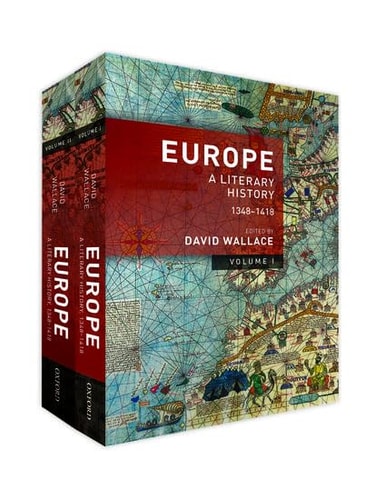
Europe: A Literary History, 1348-1418
0
0
As an Amazon Associate and affiliate partner, Menrva Books earns from qualifying purchases. Learn more
Author Description
This collaborative literary history of Europe, the first yet attempted, unfolds through ten sequences of places linked by trade, travel, topography, language, pilgrimage, alliance, disease, and artistic exchange. The period covered of 1348 to 1418 provides deep context for understanding contemporary developments in Europe, particularly as initiated by the destruction and disasters of World War II. We begin with the greatest of all European catastrophes: the 1348 bubonic plague, which killed one in three European people. Literary cultures helped speed the recovery from this unprecedented 'ground zero' experience, providing solace, distraction, and new ideals to live by. Questions of where Europe begins and ends, and disputes over whom truly 'belongs' on European soil, are explored through writing. A war that would last for a century convulsed much of western Europe. Divisions between Orthodox and Roman Catholic Christianities endured, and in 1378 the West divided again between popes of Avignon and Rome. Arabic literary cultures linked Fes and Granada to Jerusalem and Damascus; Persian and Turkish writings began to flourish south and west of Constantinople; Jewish intellectuals treasured Arabic texts as well as Hebrew writings; Armenian colophons proved unique. From 1414-18 western nations gathered to heal their papal schism while also exchanging literary, humanist, and musical ideas; visitors from the East hoped for commitment to wider European peace. Freed from nation state historiography, as bequeathed by the nineteenth century, these 82 chapters freshly assess the free movement of European literature in all its variety, local peculiarity, and regenerative power.
Menrva's Summary
THE THESIS
This work investigates how literary cultures across Europe functioned as a mechanism for societal recovery and identity formation in the wake of the 1348 bubonic plague. David L. Wallace, a scholar of medieval literature, coordinates a collaborative effort to re-examine the period between 1348 and 1418. By moving away from traditional nation-state historiography, the text argues that literature served as a vital connective tissue for a continent fractured by war, religious schism, and demographic collapse. The analysis utilizes a diverse array of texts to map the movement of ideas across borders, challenging conventional boundaries of European identity.
THE SCOPE MAP
What You Will Find
- A comprehensive analysis of literary production across Europe, North Africa, and the Near East between 1348 and 1418.
- A thematic framework organized by geographic and cultural nodes, including trade routes, pilgrimage paths, and diplomatic alliances.
- Examination of diverse linguistic traditions, including Arabic, Persian, Turkish, Hebrew, and Armenian influences on European thought.
- Case studies on the impact of the Great Schism and the Hundred Years' War on intellectual and artistic exchange.
THE AUTHORITY PERSPECTIVE
Scholars and historians frequently cite this work for its ambitious scope and its departure from traditional, state-centric historical narratives. Readers often note the academic density of the prose, which serves as a foundational resource for those studying the intersection of medieval literature and geopolitical history.
Page Count:
968
Publication Date:
2021-03-21
Publisher:
Oxford University Press
ISBN-10:
0198870663
ISBN-13:
9780198870661
History
Cultural History
Literary Criticism
European History
Community Tags
Similar Books