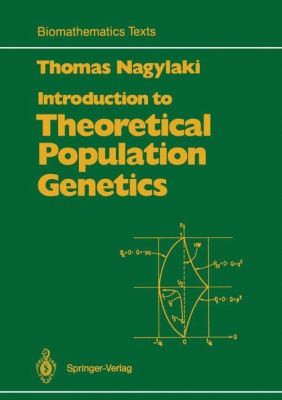
Introduction to Theoretical Population Genetics
0
0
As an Amazon Associate and affiliate partner, Menrva Books earns from qualifying purchases. Learn more
Author Description
This book covers those areas of theoretical population genetics that can be investigated rigorously by elementary mathematical methods. An attempt has been made to formulate the various models fairly generally and to state the biological assumptions quite explicitly. The choice and treatment oftopics should enable the reader to understand and evaluate detailed analysesof many specific models and applications in the literature. The materialsuffices for a one-year course and is almost entirely self-contained. The little basic genetics needed for understanding it is presented in the text. Calculus and linear algebra are used freely. Previous exposure to elementary probability theory would be helpful. The major mathematical theme of the book is the dynamical analysis of recursion relations. Many exact and approximate techniques for investigating linear and nonlinear recursion relations in one dimension and in several dimensionsare developed and applied. The problems are an essential part of this book. Although some of them ask the reader merely to supply details of derivations in the text, many illuminate, rigorize, or extend these derivations. Some of the results in the problems are useful and important. They vary in difficulty; the harder ones offer a challenge even to good students.
Menrva's Summary
THE THESIS
This book rigorously investigates theoretical population genetics using elementary mathematical methods. The author, Thomas Nagylaki, aims to present models with explicit biological assumptions and general formulations, enabling readers to understand and evaluate detailed analyses in the literature. The material is designed for a one-year course and is largely self-contained, requiring only basic genetics, calculus, and linear algebra, though prior probability theory is helpful. The central mathematical theme is the dynamical analysis of recursion relations, exploring various techniques for linear and nonlinear relations in one and multiple dimensions.
THE SCOPE MAP
- Covers areas of theoretical population genetics amenable to rigorous mathematical investigation.
- Formulates models generally with explicit biological assumptions.
- Develops and applies exact and approximate techniques for analyzing linear and nonlinear recursion relations.
- Includes problems that are integral to the book, ranging from supplying derivation details to extending concepts.
- Requires calculus and linear algebra; prior probability theory is beneficial.
- Presents necessary basic genetics within the text.
- Focuses on the dynamical analysis of recursion relations as a major mathematical theme.
THE AUTHORITY PERSPECTIVE
This text is structured to provide a comprehensive understanding of theoretical population genetics for advanced students. The mathematical rigor and self-contained nature, as described, suggest it serves as a robust foundation for further study in the field. The inclusion of problems as essential components indicates a pedagogical approach focused on active learning and deep comprehension of the analytical techniques presented. The book's focus on elementary mathematical methods makes complex topics accessible to those with a solid mathematical background.
Page Count:
369
Publication Date:
2012-01-01
ISBN-10:
3642762166
ISBN-13:
9783642762161
Science
Non-Fiction
Biomathematics
Evolutionary Biology
Genetics
Mathematical Biology
Population genetics
Community Tags
Similar Books